
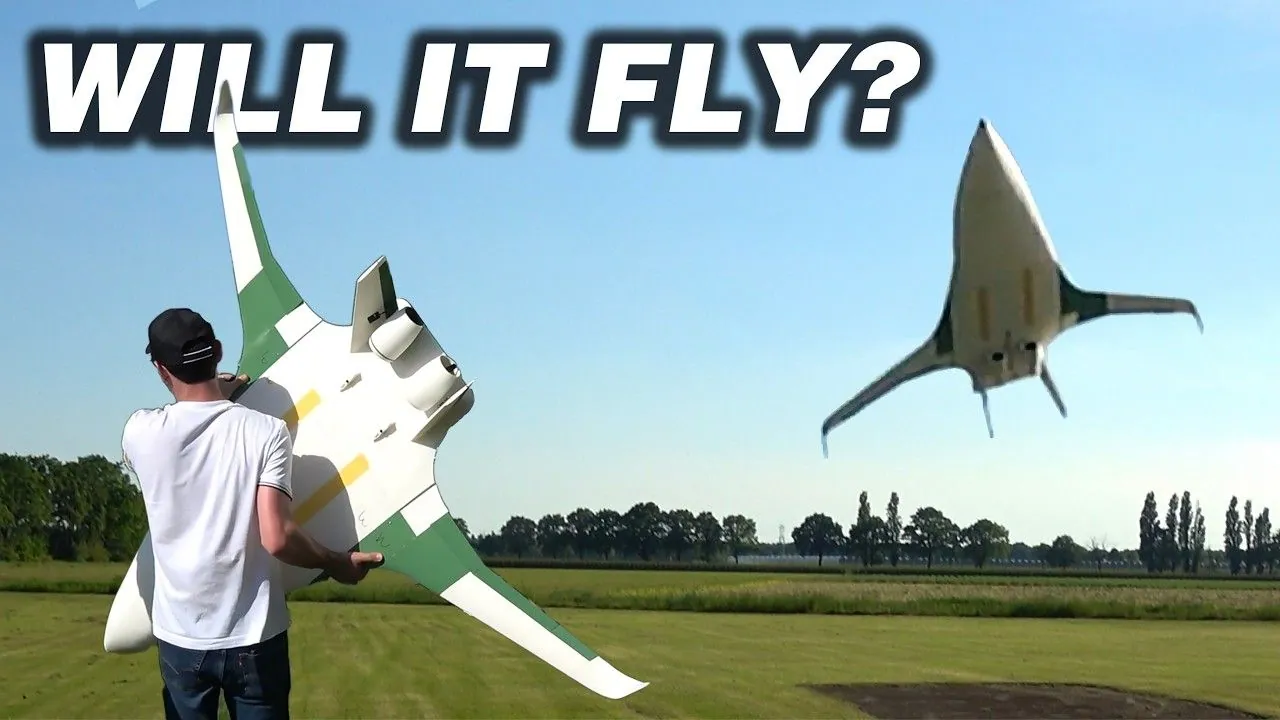
YouTube builder Ramy RC has crashed five 6-foot (1.8-meter) 3D-printed models of the Natilus Horizon since June and landed one, and the 24-foot (7.3-meter) prototype he built for the San Diego aircraft startup still has not flown. He explained why in a video published September 25, which passed 527,000 views in ten days.
The big Horizon is parked in his US workshop. Ramy says the runway he has access to leaves about 50 feet (15 meters) of margin for rotation, and the computer simulation that called the runway long enough never accounted for the thrust angle of the high-mounted electric ducted fans, which push the nose down on the ground. Both reasons, he says, put the maiden flight on hold until smaller models could show how the airframe behaves.
Three 3D-Printed Models Crashed Within Two Days at a Dutch Airstrip
Ramy built the first three 6-foot models with Joel Vlashof, a Dutch engineer known for 3D-printed VTOL Harrier and F-35 models, after six weeks of reworking the design for printing. All three crashed within two days at Vlashof’s airfield in the Netherlands, two on takeoff and one after lifting off.
Each model tested a different fix for the nose-down thrust problem. The first copied the big prototype’s motor placement and added a thrust-vectoring fin tilted about 5 degrees, adjustable to 10 degrees from the transmitter in flight. The second moved the fans to the tail, lower on the fuselage, at a fixed 5 degrees down. The third kept the original position, lowered, with vectoring. Ramy printed one in his own shop and Vlashof two on his Bambu Lab H2D printers, carbon-fiber filament for the wings and ASA Aero for the rest, over carbon-rod spars.
The crashes came before the fixes could be compared. Ramy pulled full up on the first model to save a bad takeoff and it over-rotated and flipped. The second could not hold the narrow strip, partly because its wheels had no bearings, and ran onto the grass twice. On its third attempt it lifted off and crashed because a 5 percent static margin, the distance between the center of gravity and the wing’s aerodynamic center, made the elevons far too sensitive. The third model failed the next day, even from grass. Ramy’s conclusion was a much longer runway and a center of gravity further forward.
A Drop From a Homemade Carrier Plane Proved the Horizon Flies
Vlashof printed 3-foot (0.9-meter) Horizons. Ramy built a foam carrier plane with a release hook to drop them at speed. The first drop flew stable on two servos and one small fan, with the center of gravity moved forward and the fan tilted 4 degrees.
The landing failed. Back at 6 feet, Ramy added more power, better wheels and CNC-machined aluminum parts, and took a model to an airport runway. It rotated but was so nose-heavy that full elevator could not make it climb. It turned, hit a tree and is still up there, minus the batteries and heavier parts that fell out.
The Last Model Landed on the Third Day of JetPower
Ramy brought the final two models to JetPower, the jet model show at Breitscheid airfield in Germany, for its long runway, where the first lost power when tape went into its single 12S ducted fan. The last model took off the next day, flew a circuit and landed.
The fan exploded when the tape went in. JetPower ran September 4 to 6 this year, and the landing came on its third day. Ramy says in the video that the same adjustments now go onto the full-scale Horizon, which he plans to fly from a large airport or a desert with room to rotate and land. He gives no date. The video carries no weights, speeds or flight data, and Ramy calls the work prototyping that is also a hobby for him and Vlashof.
The 24-foot prototype, a carbon-fiber skin over a wood and foam skeleton built with Natilus, dates from a two-part series Ramy published on December 12, 2025 and January 30, 2026. Natilus pitches the Horizon as a 200-seat competitor to the Boeing 737 MAX and Airbus A321neo. In February it raised $28 million, redesigned the jet as the dual-deck Horizon Evo for service in the early 2030s, and said its Kona cargo aircraft, the American comparison to China’s HH-200 cargo drone, would fly full-scale within 24 months.
DroneXL’s Take
The most useful thing anyone has published about the Natilus Horizon this year is this video, and Natilus didn’t make it. Renders and order books tell you nothing about a blended wing’s behavior at rotation. A simulation that ignores thrust angle, pointing a 24-foot airframe at a 50-foot margin, is the lesson every DIY fixed-wing builder learns at the field, usually by rebuilding, and Ramy learned it on 6-foot prints instead. A 3D-printed model says nothing about certifying a 200-seat jet, any more than Tom Stanton’s wind-up plane did. But center of gravity and thrust line are the same physics at every scale, and those are the two things that would have destroyed the big one. Natilus plans to fly passengers in the early 2030s. The first Horizon that actually landed was 6 feet across, and my read is that it earned more trust than anything in the press releases.
DroneXL uses automated tools to support research and source retrieval. All reporting and editorial perspectives are by Haye Kesteloo. Read our editorial standards.


