
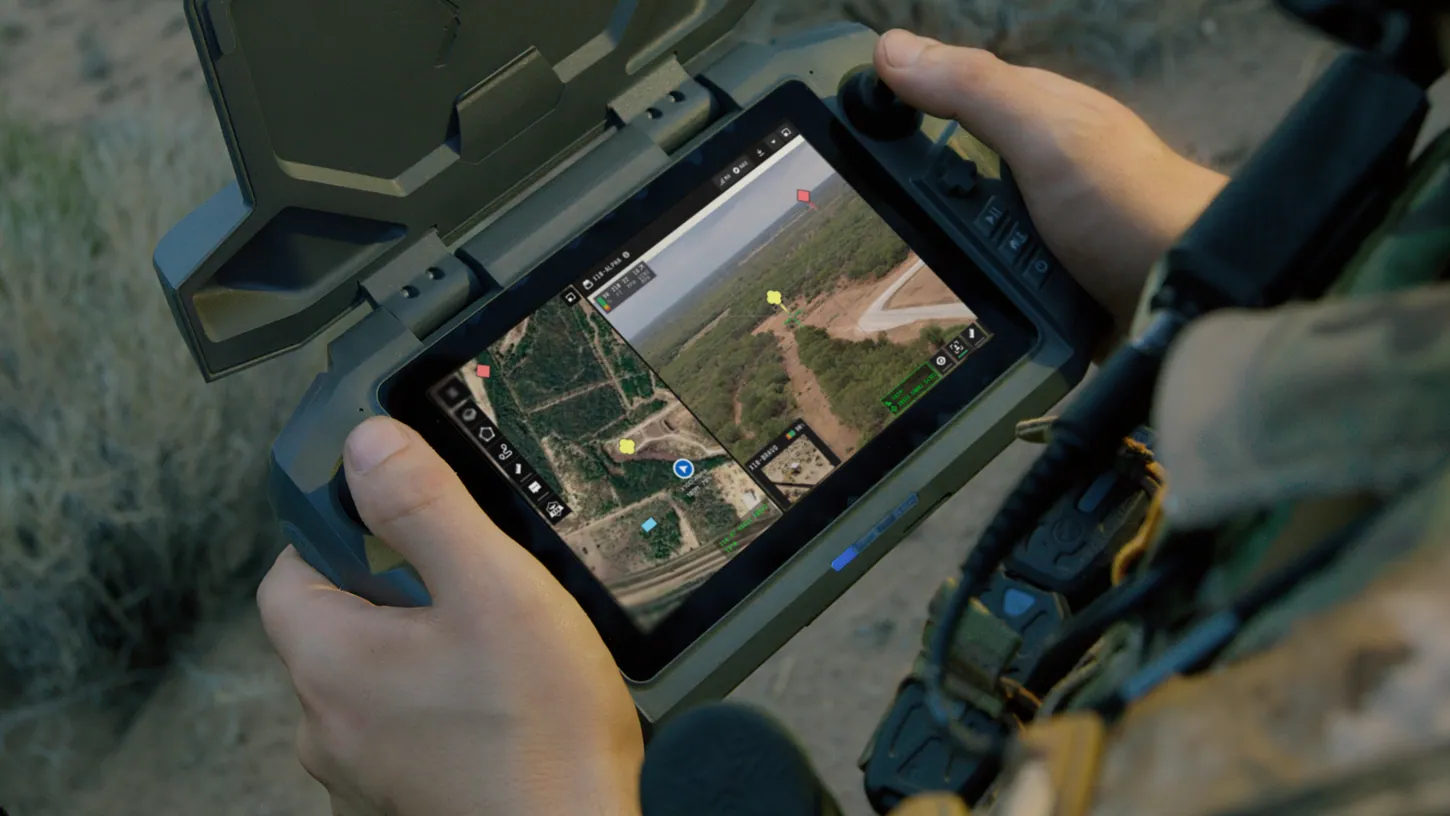
Skydio launched ISR Command on October 13, software that lets one soldier fly two X10D drones from a single controller and share target tracks across the Army’s tactical networks. Skydio says it also lets the X10D pass target locations to platforms ranging from one-way attack drones to F-16s. The company announced it the same day it livestreamed from the Association of the U.S. Army’s AUSA 2026 meeting in Washington, and says it is available now. Neither the launch post nor the product page listed a price as of October 14.
CEO Adam Bry wrote on X the next day that the launch was a big step toward one of two national security objectives he set out for Skydio. He also wrote that ISR Command “breaks the 1:1 pilot:drone ratio to enable scalable 1:many operations.” Skydio’s own launch post puts the number at two aircraft per operator.
Skydio’s Documents Describe One Operator, Two Drones and a Battery Relay
Skydio’s launch post and product page describe one multi-drone workflow step by step: a two-aircraft relay. When the first X10D runs low on battery, ISR Command tells the operator to ready a second one. That drone flies itself out and takes over once both aircraft see the target.
The operator confirms the handoff with one tap on the same controller, and the first X10D flies home. Skydio’s launch post sums it up as “One controller. Two aircraft. Continuous eyes on the objective.” The ISR Command product page says autonomy lets each operator fly more aircraft but gives no number. Both pages say ISR Command orchestrates fleets of X10Ds, and as of October 14 neither describes one operator flying more than two.
The rest of the workflow is built to take work off that soldier. Objectives arrive as TAK markers before the drone is powered on, so the operator can review terrain and assign each aircraft a role without spending battery. The X10D launches in under 40 seconds and navigates with its onboard cameras when GNSS is jammed or spoofed. Subject tracking then locks onto a vehicle or a person, and the clip on Bry’s post shows an X10D following a vehicle down a dirt road with a feature Skydio calls Shadow.
The Army has named a related bottleneck. Col. Gregory Merkl, the Army’s Drone Dominance director, said in September that hardware is no longer the gap between the Army and squad-level drone warfare and that trained pilots are, as DroneXL reported at the time.
Skydio Says ISR Command Lets the X10D Pass Target Locations to Strike Platforms
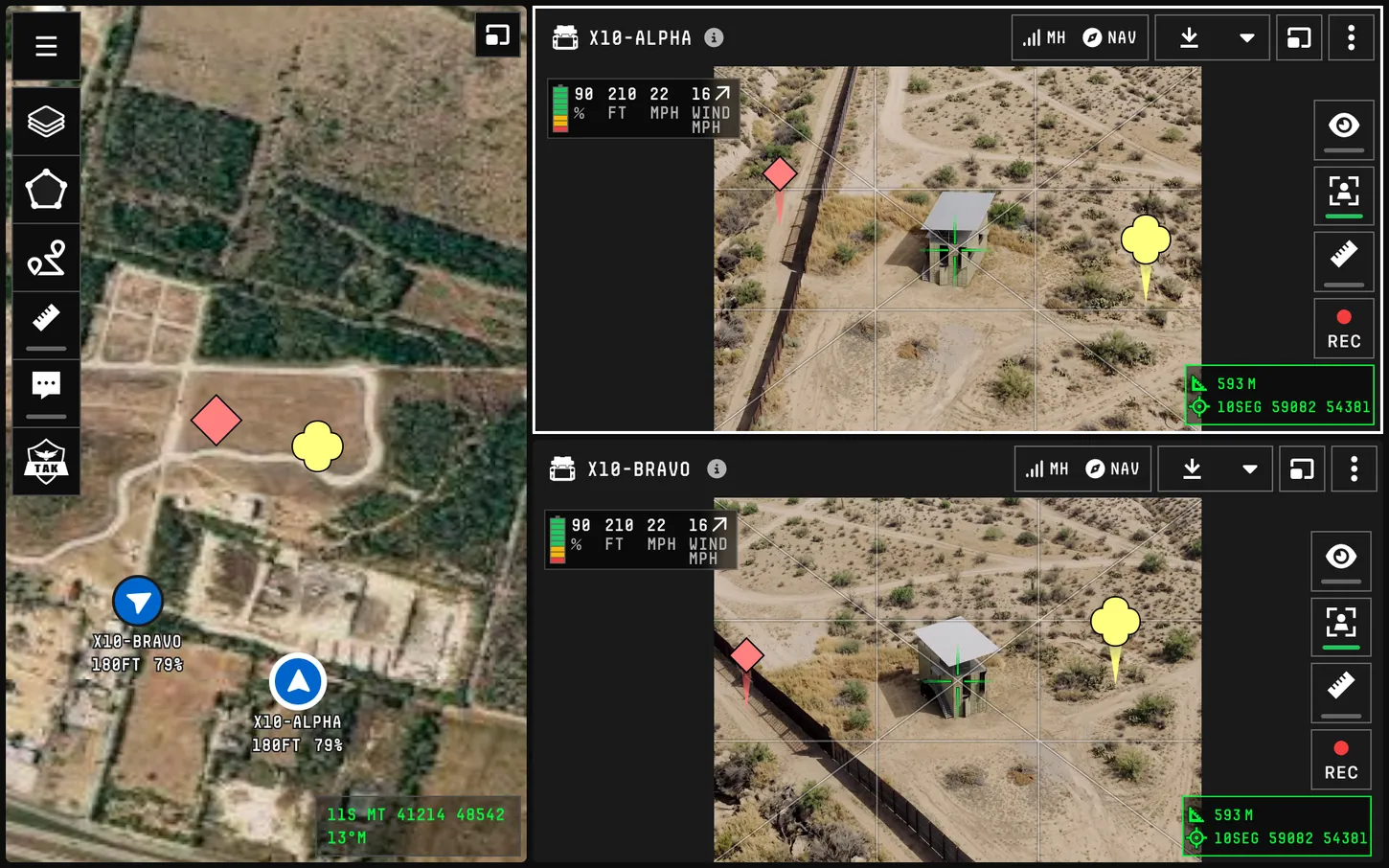
ISR Command embeds the X10D’s target location in live video, using MISB ST 0601 (STANAG 4609) for static targets and MISB ST 0903 for moving ones. Skydio says that makes the 4.72-pound (2.14 kg) X10D the smallest UAS on the market capable of delivering precise target locations to strike platforms.
Once a target is confirmed, the operator passes the grid and the camera stays on the target for battle damage assessment. The product page puts terrain-corrected crosshair coordinates on live video out to 3.1 miles (5 km).
The software is TAK-native and runs on the Skydio Controller, so markers and chat sync with other TAK users without a second device. Skydio also says it shares tracks with the Army’s Next Generation Command and Control system, NGC2. In June the Army picked Anduril to lead the NGC2 common data layer baseline on Anduril’s Lattice and Palantir’s Foundry, Breaking Defense reported. Skydio’s AUSA livestream listing promised one operator managing multiple aircraft while sharing data across TAK and Lattice.
Army Secretary Daniel Driscoll told senators in May that Ukraine’s Delta puts every drone and shooting platform on one network and that the Army’s does not, as DroneXL reported in August. I read Skydio’s TAK, NGC2 and Lattice language as a pitch aimed at that gap, and Army testing will show how much of it the software closes.
The X10D is the drone the Army ordered more than 2,500 of in March, in a $52 million-plus order Skydio called the largest single-vendor tactical sUAS order in Army history. Bry described the X10D then as a “hunter” that finds targets for one-way attack munitions. ISR Command is the fourth product in Skydio’s Command software line, after DFR Command and the Asset and Security Commands it launched at Ascend on September 23, where it also unveiled the F10 Lightrunner.
DroneXL’s Take
I think ISR Command is a useful product for the Army, and Skydio’s launch post is plain about what it does: it names one-way attack drones and F-16s as the receivers of the X10D’s target data. A small drone that holds a target and puts a precise grid on it is half of any strike, and I’d rather American units get that from an American drone.
Skydio’s principles page is less plain. Its Engagement and Responsible Use Principles, dated July 13, 2020, are still on its website as of October 14 and still say “We will not put weapons on our drones,” alongside a pledge to oppose fully autonomous lethal weapons. Nothing in the ISR Command materials puts a weapon on the X10D, though Army soldiers dropped live grenades from one in 2025 tests. In June Bry told The Verge he had gotten some things wrong on weapons. A company that markets its drone as the targeting half of a strike, with a CEO who says he got that question wrong, should update a 2020 page that still says it will not put weapons on its drones.
Sources: Skydio, Skydio ISR Command product page, Adam Bry on X, Skydio AUSA livestream, Breaking Defense.
DroneXL uses automated tools to support research and source retrieval. All reporting and editorial perspectives are by Haye Kesteloo. Read our editorial standards.


