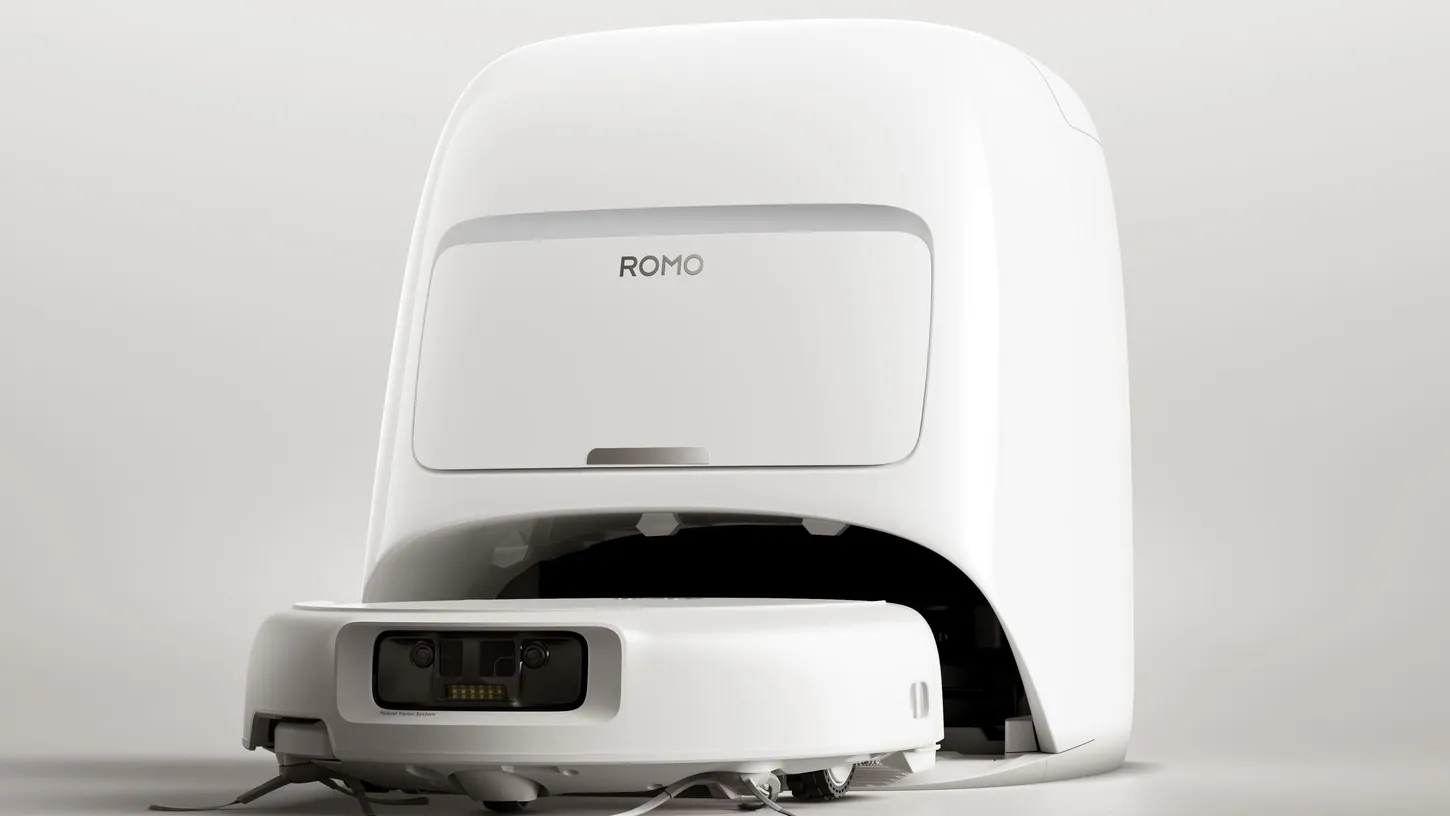
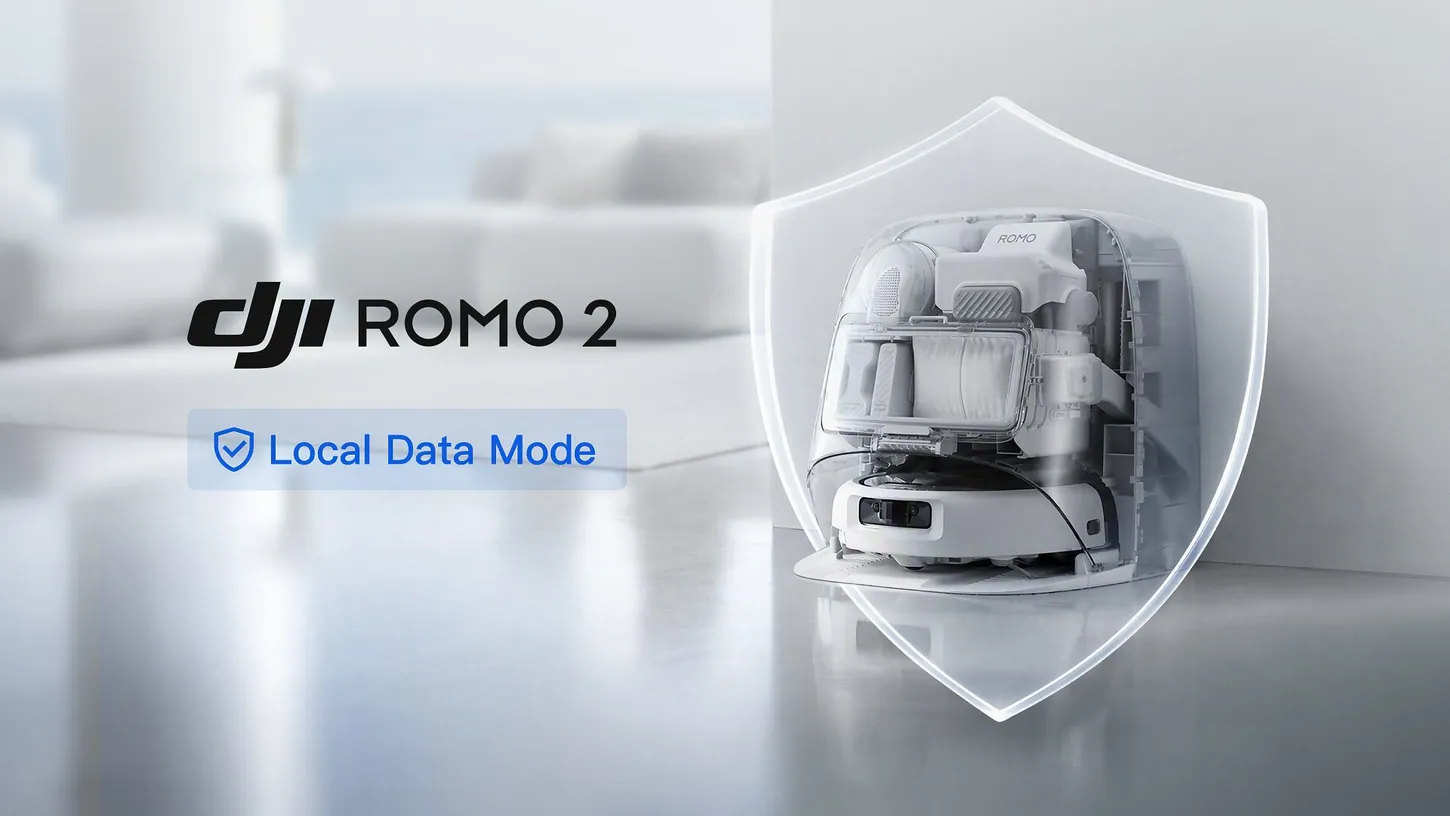
DJI switched on Local Data Mode for its ROMO 2 robot vacuum on October 29, a setting that cuts the DJI Home app off from the internet and keeps the robot’s maps and images on the device. The robot still navigates, dodges obstacles, runs scheduled cleans and returns to its dock without a connection. DJI shipped the same mode on its drones in 2017, and it has been the company’s standing answer in data-security hearings since.
In February a researcher in Barcelona pulled live camera feeds and floor plans from roughly 7,000 ROMO vacuums in 24 countries through DJI’s own cloud, and DJI later paid him $30,000 for the find. Local Data Mode is built to keep that data off DJI’s servers in the first place.
DJI has never sold a ROMO in the United States. The ROMO 2 opened for reservations in China in May and made its European debut in Berlin in September, and the October 29 announcement names no US launch.
Local Data Mode Keeps Maps on the Robot After One Online Setup
Local Data Mode stores the ROMO 2’s maps, obstacle images and navigation data on the robot instead of in DJI’s cloud, according to DJI’s announcement. The robot still goes online once, on first power-up, to build its map, and uploads nothing after the mode is switched on.
The setting is off until the owner turns it on. It needs the latest ROMO 2 firmware, then Device Settings > Security Settings > Local Data Mode in the DJI Home app. DJI says future ROMO models will get it too. The release does not mention the original ROMO S, A and P, which launched in Europe in October 2025, and DJI’s ROMO Trust Center page labels the mode “Now Available on ROMO 2” only.
That same Trust Center page still describes the default arrangement: maps encrypted and stored in the DJI Cloud with end-to-end encryption. Local Data Mode is the opt-out from that default, not a replacement for it. A separate On-Site Photo toggle controls whether pictures of detected obstacles are uploaded to the app, and switching it off does not affect obstacle avoidance. An auto-delete option clears photos older than 14 days every day.
DJI backs the announcement with its audit list. TÜV SÜD ran a penetration test of the ROMO P2 and the DJI Home app in 2026 and, per DJI, found no critical, high or medium-risk issues, with an overall Low exposure rating and every finding since fixed. The ROMO line also carries ETSI EN 303 645 certification, UL Solutions’ Diamond IoT Security Rating and an EU EN 18031 cybersecurity certificate from TÜV Rheinland. All of those are DJI’s own statements of third-party results. None of them is a test of Local Data Mode itself.
The Breach DJI Is Answering Came Through Its Own Cloud, Not the Robot
The February exposure was a server problem. DJI’s MQTT message broker, which relays commands and video between ROMOs and the cloud, had no topic-level access controls. Any owner’s device token could subscribe to every ROMO on the network, and that is how Sammy Azdoufal got in.
DJI pushed automatic patches on February 8 and 10, then fixed a separate PIN bypass by late February. If the mode works as DJI describes it, a ROMO 2 running offline has nothing on that broker to leak. That is my reading of the two incidents, not a claim DJI has made. Owners who keep the default cloud setup, which is every owner who never opens Security Settings, are still relying on the access controls DJI rebuilt in February.
The drone version of the mode has the better track record. FTI Consulting’s 2024 audit of the Mavic 3T and the Pilot 2 app measured zero outbound traffic with Local Data Mode on. No comparable independent test of the ROMO 2 mode exists yet. DJI announced it six days ago.
The Covered List Keeps the ROMO 2, and Its Privacy Switch, Out of US Homes
The ROMO 2 series, P2 and A2, made its European debut at IFA Berlin in September 2026. DJI’s US site has no ROMO 2 page and the release names no US price. Since July 28, the FCC’s Covered List has barred new foreign-made advanced robotic devices from equipment authorization.
That listing uses the same country-of-origin reasoning the FCC applied to every foreign-made drone on December 22, 2025, and the FCC’s own FAQ says the robot definition can reach automated guided vehicles that follow fixed paths. A camera-equipped vacuum that maps a house on its own sits well inside it. The only exit is the Department of War’s Conditional Approval process, and the eleven companies through it by June were all drone makers, none of them Chinese.
DJI has made a habit of this at IFA. The Power 2000 balcony-solar feature launched in Berlin the same week and skipped America too. The romo.tech address DJI’s release points to shows US visitors a “Coming Soon” page with a Notify Me button and no date.
DroneXL’s Take
Local Data Mode is the right fix, and DJI is the one company that could ship it with a straight face: nine years of drone audits say the drone version does what it claims. I’d still call the default wrong. DJI put the mode behind a toggle in a submenu, after a mandatory online mapping run, on a product whose entire February embarrassment was a cloud nobody asked to be on. Kevin Finisterre found DJI’s keys in public GitHub repos in 2017. Azdoufal found an open broker in 2026. Both times the encryption was fine and the permission model was not, and both times the customer had no way to opt out of the server. DJI should flip it: ship ROMO with Local Data Mode on and let people opt into the cloud when they want the remote camera. For American readers the point is moot, because the robot that finally got the privacy switch is one the Covered List says cannot get an FCC grant.
Source: DJI via PR Newswire, DJI Trust Center
DroneXL uses automated tools to support research and source retrieval. All reporting and editorial perspectives are by Haye Kesteloo. Read our editorial standards.