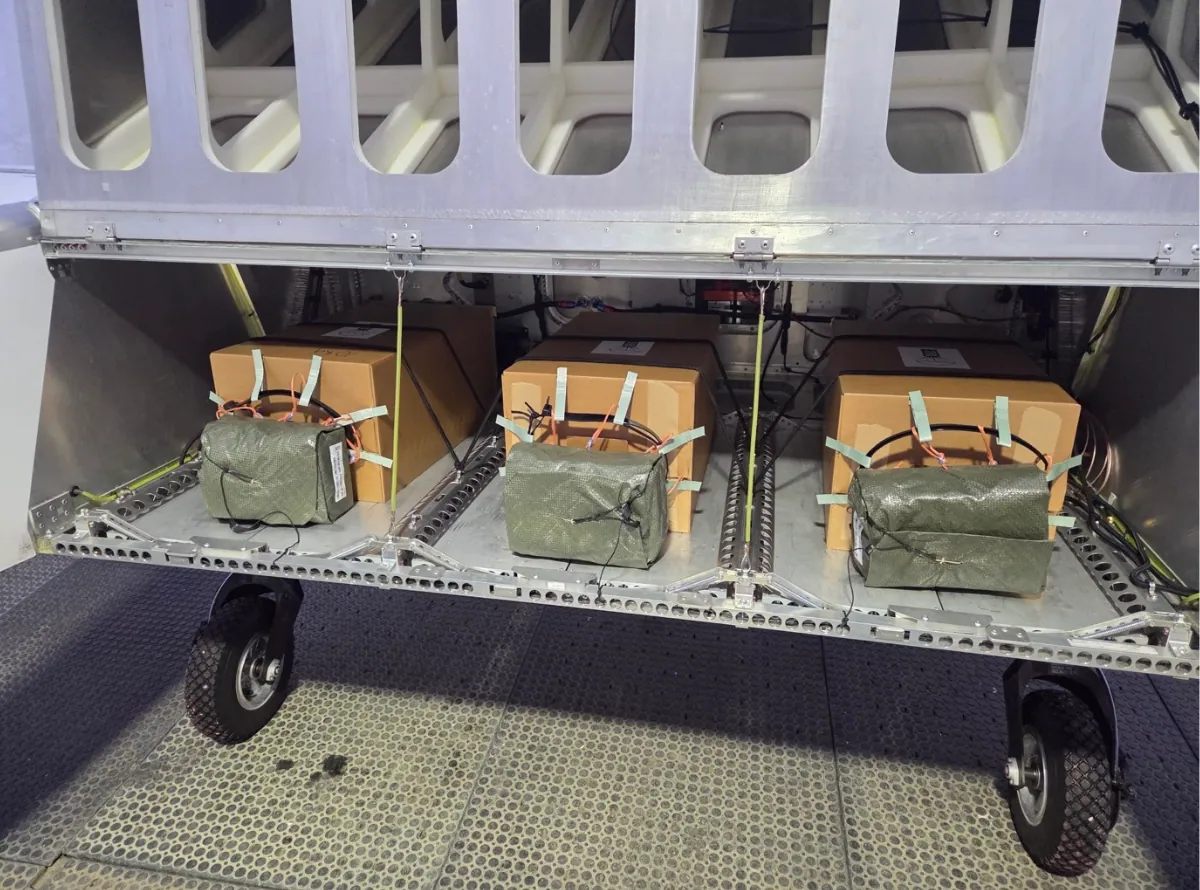
A Purdue University-owned Windracers ULTRA flew the first beyond visual line of sight (BVLOS) flight in the Indiana Drone Corridor on October 29, covering more than 50 miles (80 kilometers) out of Terre Haute Regional Airport while Governor Mike Braun, Senator Todd Young and Representative Mark Messmer watched it drop parachute boxes from its cargo bay. The flight opened the Midwest UAS Test Site of Indiana, one of two sites the Federal Aviation Administration (FAA) designated in January, bringing its test-site network to nine after nearly a decade without additions.
Windracers’ announcement says the aircraft will now be tested as a way to drop emergency supplies to Indiana communities affected by seasonal flooding. The FAA describes the program the site belongs to as support for public and civil unmanned aircraft and for the safe integration of drones into the National Airspace System.
Dale Lyles, the test site director, told WTHI that the site is partnered with the Indiana National Guard and will use the special-use airspace over Camp Atterbury for “kinetic testing as well as counter-UAS testing,” which he said will make it completely different from any other test site in the United States.
Purdue’s Flood-Relief Drone Has Flown Military Logistics For Ukraine
Windracers, the ULTRA’s British maker, has had the aircraft flying in Ukraine since 2023 and in April was named one of three primary suppliers under the United Kingdom’s £752 million drone package for Ukraine, as DroneXL reported. Purdue owns the aircraft that flew on October 29, registered N90PU.
The aircraft has an aluminum airframe, a 33-foot (10-meter) wingspan and a cargo floor that drops loads from three separate bays, according to Windracers’ announcement.
The current ULTRA Mk2 carries 441 pounds (200 kilograms) over 1,242 miles (2,000 kilometers), a range Windracers announced in January. Purdue is the company’s main university partner in the United States: its AIDA3 center, the Center on AI for Digital, Autonomous and Augmented Aviation, was launched in partnership with Windracers, and Damon Lercel, a Purdue Polytechnic associate professor on the AIDA3 team, called the opening a milestone for the Midwest in Windracers’ announcement.
The Indiana flight was the ULTRA’s second BVLOS flight in the United States. The first was a flight of about 1,000 kilometers (621 miles) from Nenana, Alaska, on August 19, carrying anti-doping blood samples for the International Testing Agency under the University of Alaska Fairbanks test site. Windracers’ Indiana release calls that flight 670 miles, while its own Alaska post and the university put it at 1,000 kilometers. Neither Windracers nor Purdue named the FAA authorization for the Indiana flight in their announcements as of November 8.
That authorization still matters because the FAA’s Part 108 BVLOS rule has been in White House review since July 10, 121 days as of Sunday. Until it is published, a BVLOS flight needs a Part 107 waiver, a Section 44807 exemption or a certificate of authorization, and the test site has not said which it holds. In September the FAA’s Robert Reckert said the agency hopes to publish by year-end.
Transportation Secretary Sean Duffy’s release on the designation said the job is to make sure the United States leads in drones, “not China.” The aircraft that opened the corridor is British.
The Site’s Director And Its Own Website Put Kinetic Testing First
The test site’s website lists Defense and Counter-UAS first among its capability areas. It defines them as kinetic testing, electronic warfare and threat mitigation, ahead of public safety and agriculture, and promises access to Camp Atterbury, Muscatatuck and Naval Surface Warfare Center Crane. A 225-plus-mile BVLOS corridor has preliminary approval.
On October 28, the day before the ribbon-cutting, Acting Army Secretary Adam Telle designated Camp Atterbury and Muscatatuck as “premier, permissive sites” for commercial drone and counter-drone testing, run through Army Test and Evaluation Command with the Indiana National Guard. Camp Atterbury brings more than 34,000 acres and restricted airspace up to 40,000 feet (12,192 meters). Young told WTHI his goal is for Indiana to lead in testing, fielding and manufacturing drones at scale “for the Department of War” and for commercial customers.
None of this was hidden in the bid. Indiana’s congressional delegation pitched the state’s military infrastructure in its December letter to the FAA, and DroneXL wrote in June that Indiana won the designation largely on defense infrastructure, with the Army’s counter-UAS experimentation work at Camp Atterbury already in place.
The FAA describes the program in civil terms. Its January 8 release says the UAS Test Site program supports the testing of public and civil unmanned aircraft and advances the safe integration of drones into the National Airspace System, with a focus on BVLOS and autonomous operations. Kinetic testing does not appear in it. Andrew Kossack, president and chief executive of the Applied Research Institute (ARI), the Bloomington nonprofit that runs the site with the Indiana Economic Development Corporation (IEDC), framed the opening around the region’s defense expertise and the strengthening of America’s “defence and industrial base.”
The IEDC And ARI Run The Site Under A Law Signed In March
The IEDC and ARI run the site under House Bill 1268, signed March 4, which puts the test site in state law as a program the IEDC administers with an “operating partner.” Both bodies were subjects of FTI Consulting’s forensic review of the IEDC, published 98 days before the designation.
Braun promised the review in April 2025 after Indiana Legislative Insight reported allegations of self-dealing at the agency, and FTI published it on October 2 with 45 findings and observations on conflicts of interest, compliance and financial oversight across the IEDC and four affiliates. On ARI, the report says the IEDC’s award grew from $2.5 million at the end of 2022 to $17.5 million in 2023, that the agreement was “drafted in broad terms,” and that the contract and progress reports did not let FTI determine how the money was used. Of the $10.6 million paid under that award by the end of 2024, ARI had spent $4.4 million. ARI told FTI the award was a fixed-fee contract and that the balance funds its mission rather than profit.
FTI said its review of ARI was limited by the security requirements of ARI’s defense work, with read-only access to documents tied to IEDC funding, and it noted that the entities had begun reforms while the review ran. Braun said the state would “take every recommendation,” the Daily Journal reported.
DroneXL’s Take
The FAA’s own words make this a civil program: public and civil aircraft, safe integration into the national airspace. Indiana’s site director and the site’s own website describe a kinetic and counter-UAS test range, and neither is hiding it. The gap sits in the FAA’s description, not in Indiana’s conduct, and I think the agency should close it. If the test-site program now hosts weapons testing over a Guard base, its public description should say so, because nobody reading the January release would guess it.
Counter-drone systems have to be tested somewhere, and restricted airspace over Camp Atterbury is the right place for it. The ULTRA has hauled real supplies for Ukrainian units for three years, so the parachute drop over Terre Haute showed a working capability rather than a prop. My objection is the label on the federal side. The FAA designated this site under a program it describes as civil integration, and the site describes itself as a kinetic and counter-UAS range. One of those descriptions has to change, and it should be the FAA’s.
Sources: Windracers, WTHI, FAA, U.S. Army, FTI Consulting, Midwest UAS Test Site of Indiana
DroneXL uses automated tools to support research and source retrieval. All reporting and editorial perspectives are by Haye Kesteloo. Read our editorial standards.