Your Part 107 is going to make you legal, which is awesome, and you need to do that. But it doesn’t actually get you the clients. So a few weeks ago we surveyed about 516 drone pilots. Some of them haven’t been paid for a single job yet, and some of them have been flying full-time for quite a while. We found that the ones earning over $10,000 a year were usually doing three things that the rest were not.
I’m Greg Reverdiau, co-founder and head of training at Pilot Institute. I brought three guests on a live webinar to talk about each of those three things: Billy Kyle on finding clients, Jared Janacek on keeping them, and Ross Mathews on pricing. The survey data has never been shown publicly before.
Six in 10 Surveyed Pilots Have Not Been Paid for Drone Work Yet
About six in 10 of the pilots who answered haven’t been paid yet for drone work, which is kind of expected. About one in four are getting paid but still earn under $10,000 a year. About one in 10 are past the $10,000 mark.
A lot of the unpaid group are still working on their Part 107 or flying for fun, and most of them are hoping real estate will be their first client. For most of the under-$10,000 group, it’s a side business on top of another job. The one in 10 are the pilots we really wanted to learn from.
Three things stood out when we compared them with everybody else. First, they find clients through people: past clients, referrals and partner businesses. Only about 4% of the paid pilots said ads, a website or social media posts were their top source of work, which was kind of surprising to me. Second, they keep clients on a schedule. 85% of the pilots who make over $10,000 have two or more clients on recurring work. Third, they charge what the work is worth. About half of the pilots over $10,000 raised their prices last year, compared to only 15% of the pilots under it.
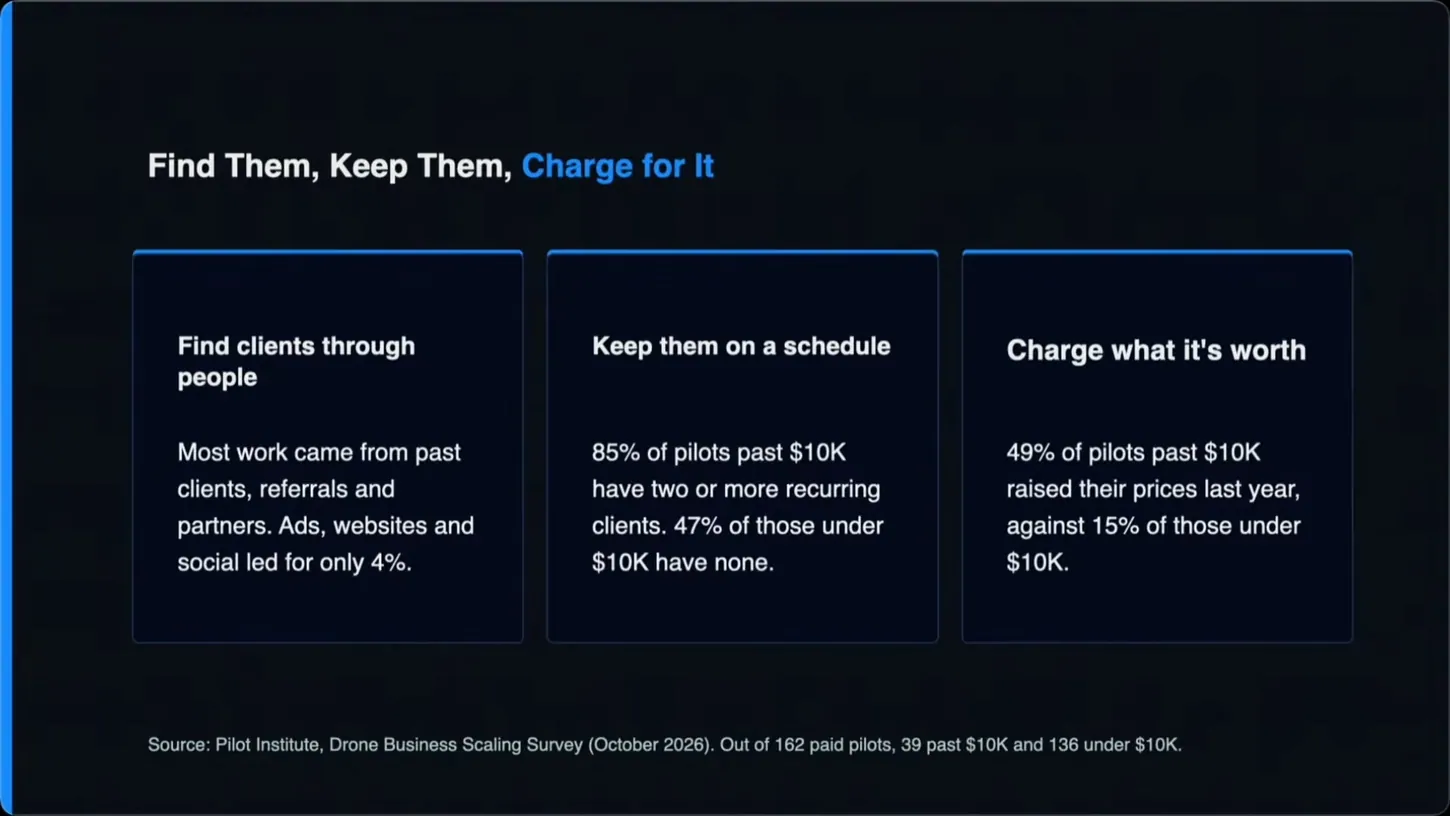
Is $10,000 a lot in this field? It sounds like very little for a year’s worth of work, but some of these people are doing this part-time. We took $10,000 because that was the line where the good habits showed up. More than $10,000 can mean $100,000 or $200,000.
Billy Kyle Gets Construction and Real Estate Clients by Word of Mouth
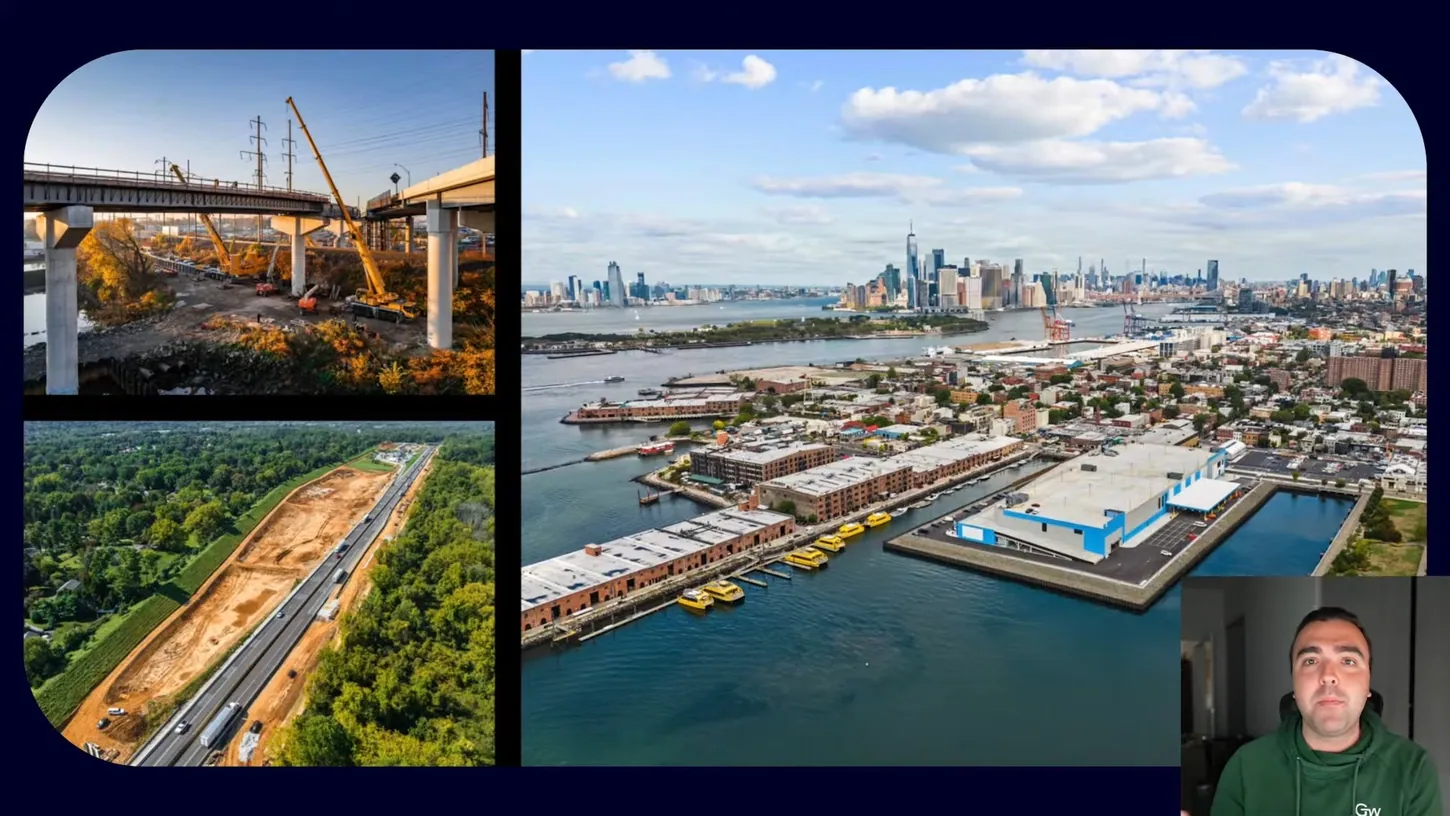
Billy Kyle has made drone videos on YouTube for almost 10 years and has run a real estate and construction media business in the Philadelphia area for about eight. He told us that in both industries, word of mouth is by far the best way to get business.
Billy has tried marketing campaigns, flyers and cold calls. Unless somebody is already looking for photos and videos, he said, they’re probably not going to give you the time of day. That is exactly what we saw in the survey. Good work for one builder gets shared, and a competitor asks where the photos came from. One agent in a Main Line real estate office liked his work, and now six or seven other agents from that office have called.
He started out wanting to just fly the drone, and quickly realized a real estate agent doesn’t want to hire one person for photos, one for video, one for the drone and one for the 360 tour. So he bought a camera and became the only media provider on the visit.
Construction is his favorite. The budgets are larger and the turnaround is looser, where real estate agents need their photos today. The work is tracking progression: photos of a house with the framing up and the drywall not on yet show where the plumbing and electrical are before the walls close. On a large site there are dozens of contractors, from the concrete guys to the engineers, and you only need to get hired by one of them. Larger projects also have public bidding websites. Real estate is where you get the higher volume. Get in with a larger real estate team and your phone rings every time they have a new listing.
If you’re at zero, Billy’s list is short. Build a portfolio on a website, Instagram or both. Set clear pricing, so that when a client asks you can say the shoot is $200 and ask whether that fits their budget. And “be easy to work with.” If the shoot is at 9:00 a.m., be there at 8:45. If they need the photos tomorrow, send them tonight.
Jared Janacek Sells the Second Flight While Booking the First
Jared Janacek has flown over 5,000 mapping missions and teaches our drone mapping courses. His Texas Drone Company is built on construction progress and stockpile inventory, the work that comes back month after month. His advice is to have the recurring conversation while you’re discussing the first job.
Ask how long the project runs, when the owner needs an update, and what the client wants to see on the next capture. Then make a recommendation, like a couple of visits a month with delivery on the 23rd so the report is done by the 25th, and put the scope in writing, including what happens when weather or scope changes. “Let me know when you need another flight” is not going to work. Assume the next flight and let the customer tell you not now.
Look for anything that changes on a deadline. Construction and inventory reporting are the obvious ones. Jared also named crop monitoring, solar inspections, which need to happen annually, and power line inspections, which may only come around every five years. Line up 15 or 20 solar sites that take a week each and you have 15 or 20 weeks of work.
His company schedules recurring captures in the first and third weeks of the month. That leaves the middle of the month for project work, which carries a higher rate: infrastructure inspection, marketing shoots, ground topos over 100 acres (40 hectares). Recurring work is billed lower per visit because it’s more efficient. Jared’s team has templates that get a capture under 30 minutes, so a pilot can hit five or six sites a day. His example was $500 a visit with an 18-month commitment against $750 for a standalone capture. “It is all about systems,” he said.
On the first visit, he overcaptures and overdelivers at his own expense: a site map, 360 photos, FPV video, creative stills, sometimes a 30- or 60-second social clip. Clients often increase their cadence after seeing it. Jared also showed Site Record, the delivery tool his team built after being priced out of other software. It puts a client’s photos, videos, maps and 360 walkthroughs on a timeline, with a slider to compare two dates. It’s in beta, and he is making it available to Pilot Institute students.
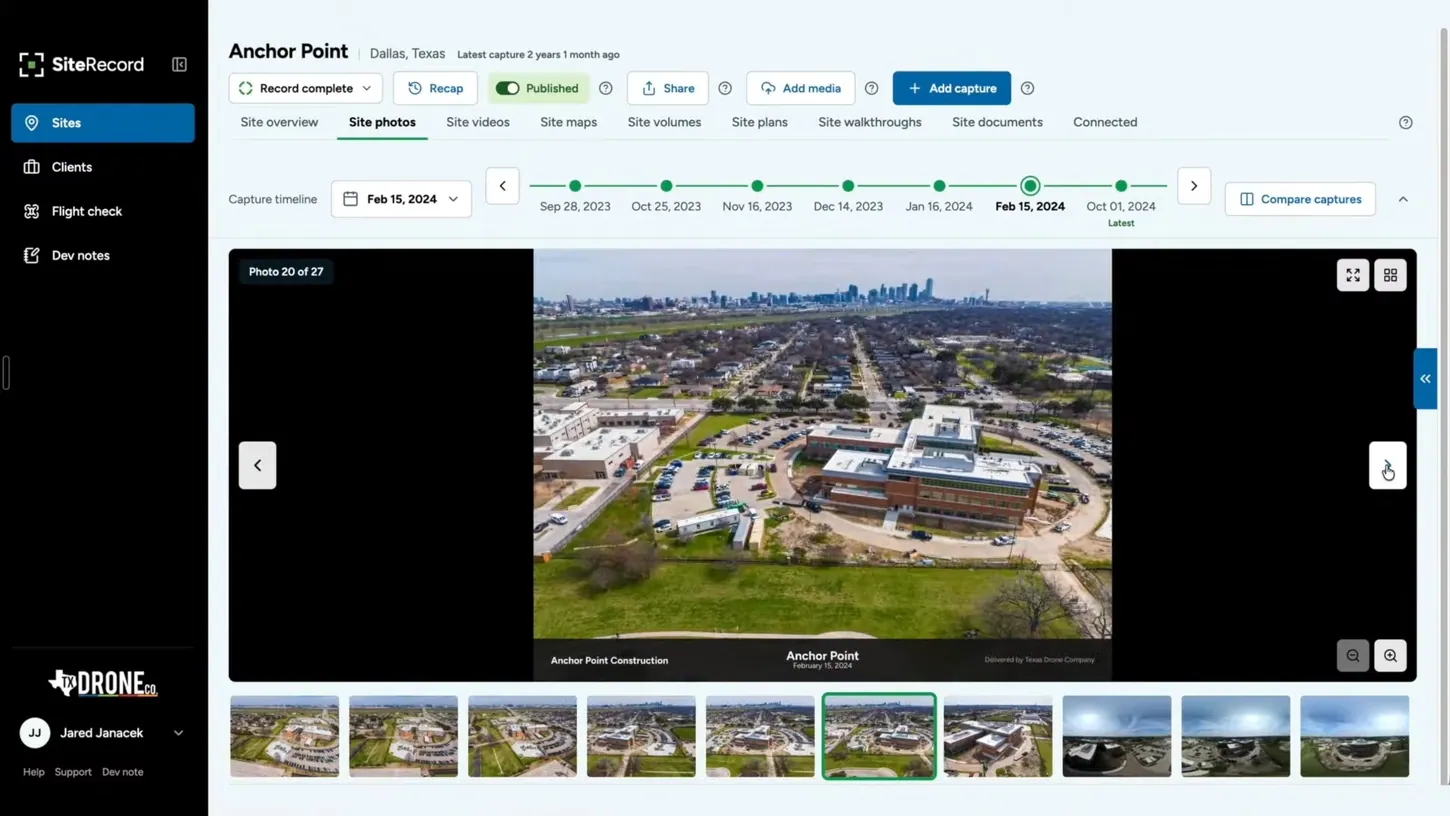
This is the clearest gap in the entire survey. 47% of the pilots under $10,000 a year don’t have a single client on scheduled work, and only 11% of them called it their biggest problem. Newer pilots don’t even realize this is what’s holding them back.
Ross Mathews Prices With a Cost-Plus Model and Does Not Discount
Ross Mathews runs Atlas Drone Co and is one of our students. He bought a DJI Mini 3 Pro, flew missions for Spexi and FlyGuys, and grew that into a big mapping contract. He prices on cost plus margin, and he has not lowered a rate because cheaper pilots exist.
The gig companies paid him to learn, with little or no ability to negotiate. When he moved into enterprise drones he bought secondhand. His first Mavic 3 Enterprise came from somebody in our community, a cash deal in a police department parking lot. He kept his other businesses, commercial finish-out construction and line striping, and he wouldn’t encourage anyone to quit their job to jump in.
Clients want to see finished products before you have any clients. Ross got past that by mapping commercial properties and construction projects around him, safely and legally, and by flying sites his other businesses already worked on. Before presenting to a property management company, he flies one of their own properties.
For pricing, he used the cost-plus model from our Drone Business Made Easy course. He divided the price of each drone by the number of missions he wanted to pay it off in, then added insurance, courses, trade shows, an hourly rate and a margin. He also tells clients the job is much more than the flight: an hour on site can mean hours of driving and overnight processing.
His clients come mostly from networking: Commercial UAV Expo, Geo Week, local trade shows, and city planning and town hall meetings. His biggest lesson is not to buy equipment before you need it. He bought a thermal Matrice 30T, got thermal certified, and has yet to truly break into that work. You can rent. In a presentation, his advice is “just shut up and listen.”
Three Quarters of Pilots Who Raised Prices Did Not Lose a Client
Pricing came up as the second biggest problem in the survey, because a lot of pilots are scared that raising their prices will cost them clients. Of the pilots who actually raised their prices last year, three quarters did not lose a single client.
The Q&A covered the rest. For a starter drone, Billy flies a Mini 5 Pro on his real estate shoots every day and said anything from the Mini 3 to the Mini 5 is good, new or used. Real estate is not really a high-dollar industry, he said, so he doesn’t want to risk a $4,000 or $5,000 Mavic 4 Pro on those shoots. Jared’s team is heavy on the Mavic 3 Enterprise as a first mapping drone, and he built his business on a Phantom 4. Ross moved from the Mavic 3 Enterprise to the Matrice 4 for wind and larger projects.
Billy really doesn’t fly over people at all. If you need to, he pointed to AVSS parachutes. You register the drone with the parachute, and then you can fly over people as long as you adhere to the rules. He also doesn’t charge usage rights. He bills per square foot, once, and would rather keep the client calling.
The number one competitor is the in-house pilot. Jared’s answer is to find the contractor’s pain point. His clients have dozens of sites, and his company captures all of them on the same day and delivers the next day. On property boundaries, Ross is not a surveyor and doesn’t plan to be. He and Jared partner with them, and Ross wants every surveyor’s number in his phone. Billy draws lot lines from tax records as an approximation and has the agent say so in the listing.
I also see a lot of questions about thermal. We have thermal training coming early next year. And yes, level one thermography certification is becoming an expectation in certain industries.
We put the survey and our guests’ guidance into a free scaling checklist. You pick the kind of drone work you’d like to do and it shows you the first steps. Our Black Friday sale is also live until the Wednesday after Black Friday: 30% off one course, 40% off two, and 50% off three or more.
This article is based on a video from our YouTube partner Greg Reverdiau. Watch the full video on the Pilot Institute YouTube channel, and find more of Greg’s work on his DroneXL author page.
Source: Pilot Institute / YouTube
Advertise with DroneXLYour company hereReach 200,000+ drone readers a month with a sponsored article, a banner on your beat, or a partnership.See the options →