CJNG’s Tech Arsenal: How Drones, AI, and TikTok Kept Mexico’s Most Dangerous Cartel Running After El Mencho’s Death

Check out the Best Deals on Amazon for DJI Drones today!
Mexican Army Special Forces killed Nemesio Rubén “El Mencho” Oseguera Cervantes this past weekend in Tapalpa, Jalisco — the most wanted drug lord in Mexico, with a $10 million US bounty on his head. Within hours of federal confirmation, the predictable question surfaced: does the Jalisco New Generation Cartel (CJNG) die with him? The answer, according to security researchers, law enforcement analysts, and the cartel’s own operational record, is no. And a big reason why comes down to technology.
A new report in Wired en Español maps exactly how deeply the CJNG embedded drones, artificial intelligence, and social media into its structure — not as novelties, but as core operational infrastructure.
- El Mencho is dead. Mexican Army Special Forces killed CJNG leader Nemesio Rubén Oseguera Cervantes this past weekend in Tapalpa, Jalisco, per Mexican federal authorities.
- The cartel survives the man. The CJNG operates as a decentralized network with multiple commanders and specialized franchises. Its drone units, AI-assisted fraud operations, and social media recruitment arms run independently of any single leader.
- Drone attacks surged from 5 in 2020 to 260 in the first half of 2023 alone, using modified DJI Mini 3 consumer drones and DJI Agras T40 agricultural models capable of delivering toxic payloads. These figures come from Mexico’s Ministry of National Defense (SEDENA), as cited by Wired en Español.
- TikTok became a recruitment pipeline. A joint study by El Colegio de México and Northeastern University’s Civic A.I. Lab identified 100 active cartel-linked accounts on the platform. The CJNG accounted for 54.3% of them.
CJNG’s Drone Program Grew From Five Attacks to Hundreds in Three Years
The CJNG’s drone warfare capability began roughly five years ago in Michoacán, starting with crude explosive-carrying quadcopters aimed at rival factions. By 2020, Mexico’s Ministry of National Defense (SEDENA) recorded just five drone attacks attributed to criminal groups. That number grew fast: 107 in 2021, 233 in 2022, and 260 in the first half of 2023 alone. Since 2023, Michoacán state police have deactivated close to 5,000 explosive devices — land mines and armed drones both — used by various criminal organizations to hold trafficking routes.
We’ve been tracking this escalation at DroneXL for years. Back in August 2023, I wrote about the CJNG’s elite “Operadores Droneros” unit — a specialized squad whose patch features a quadcopter drone, a skull, and the words “Operadores Droneros.” The unit was trained initially by foreign instructors, including an American explosives expert and a Colombian who taught drone maneuvering. At the time of that 2023 report, the unit had roughly a dozen members. That was two and a half years ago.
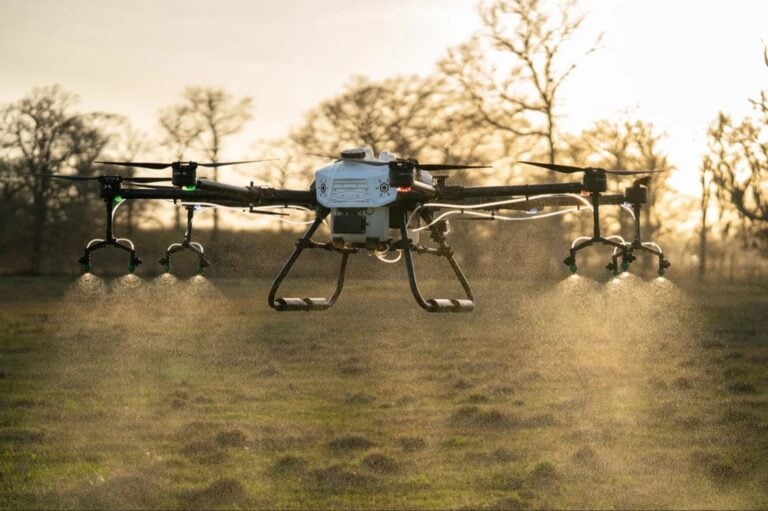
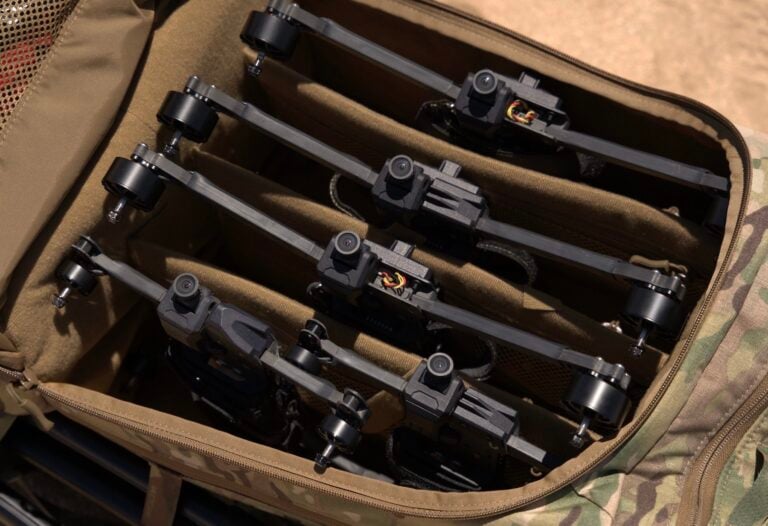
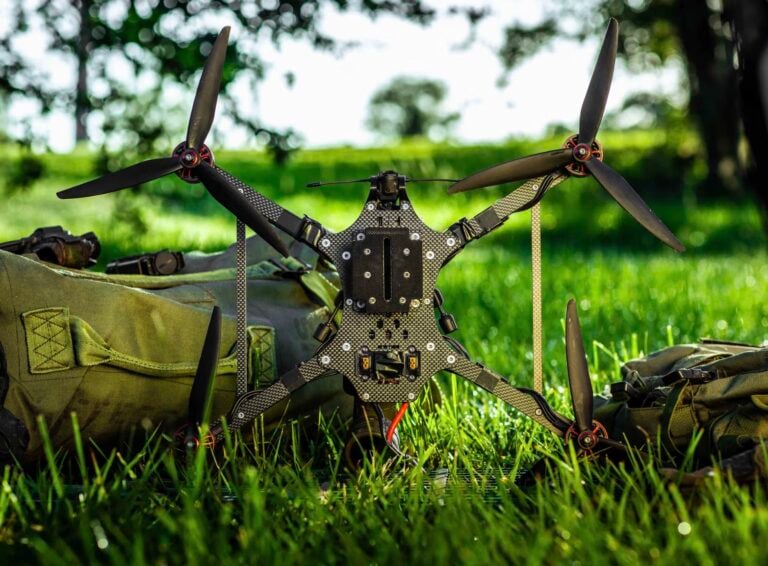
The hardware choices are telling. Cheap consumer gear handles the high-volume harassment work. A DJI Mini 3 — priced at roughly 7,000 Mexican pesos (approximately $419 USD at the time of Wired’s reporting) — gets modified with galvanized tubes packed with gunpowder, pellets, or metal fragments: essentially a flying pipe bomb. For heavier operations, the cartel uses the DJI Agras T40, an agricultural sprayer drone that costs around $25,000 and can carry liquid payloads. In cartel hands, that means toxic substances or liquid explosives. The same machine designed to protect crops gets turned against people.
As we reported in November 2025, the tactics themselves are directly borrowed from the Ukrainian battlefield. In October 2025, three drones detonated outside a prosecutor’s office in Tijuana, shredding six vehicles with nails, BBs, and metal fragments. The shrapnel load and delivery method matched FPV drone attack patterns documented in eastern Ukraine — and that’s not coincidence. Our July 2025 reporting confirmed that cartels were actively seeking to recruit people with Ukrainian battlefield drone experience.
AI and TikTok: The CJNG’s Recruitment and Fraud Infrastructure
Beyond drones, the CJNG built an AI-assisted operational layer covering recruitment, financial fraud, and money laundering that functions entirely separately from any physical command structure. A 2024 Interpol warning flagged cartel involvement in large-scale financial scams using AI language models and cryptocurrencies. The CJNG’s financial wing, known as Los Cuinis and headed by Abigael González Valencia (El Mencho’s brother-in-law), coordinates laundering through international trade, crypto networks, and connections to Asian financial networks.
The TikTok finding from the El Colegio de México and Northeastern University’s Civic A.I. Lab study is hard to ignore. Of 100 active cartel-linked accounts identified on the platform, 47% were actively recruiting new members and 31% were pushing propaganda. The CJNG ran more than half of those accounts. Researchers also found that cartel structures use predictive algorithms to map optimal trafficking routes, reducing operational risk — the same kind of logistics optimization that e-commerce companies use to route deliveries.
AI-simulated kidnappings and identity impersonation round out the toolkit. These aren’t sophisticated nation-state operations. They’re commercially available tools, repurposed. That’s precisely what makes them hard to stop.
The CJNG Operates in More Than 40 Countries — El Mencho’s Death Changes the Leadership, Not the Network
The DEA describes the CJNG as present in more than 40 countries, with the US State Department noting contacts across nearly all of Mexico, the Americas, Australia, China, and Southeast Asia. Its criminal portfolio covers fentanyl trafficking, extortion, migrant smuggling, oil and mineral theft, and arms dealing. This is not a cartel built around one man’s relationships. It’s a franchise model with specialized cells, each with distinct financing and logistics arms.
Security experts cited in the Wired en Español report are clear on this point: the CJNG’s operational capacity doesn’t collapse with the death of its leader. History supports that. The Sinaloa Cartel survived El Chapo’s extradition. The Knights Templar splintered after Nazario Moreno’s death but the splinter groups kept fighting. Fragmentation may follow El Mencho’s killing — new criminal cells could form — but the technological infrastructure doesn’t need a kingpin to keep running.
In February 2026, just days before El Mencho’s death, we reported on research documenting 221 cartel drone incidents across 2021–2025, with the National Counterterrorism Innovation, Technology, and Education Center (NCITE) describing cartel drone programs as a low-cost air force. Note that this NCITE dataset and the SEDENA attack statistics cited above cover different reporting periods and methodologies — both point in the same direction, but the numbers aren’t directly comparable. The infrastructure behind both counts predates El Mencho’s death and will outlast it.
DroneXL’s Take
I’ve been covering cartel drone use since 2023, and what the Wired en Español report makes clear is something I’ve argued here before: the drone threat from cartels stopped being a curiosity a long time ago. It’s now doctrine.
The jump from 5 attacks in 2020 to 260 in six months of 2023 isn’t a spike. It’s a program. Specialized operators, foreign training, dedicated hardware budgets, tactical doctrine copied from active warzones — this is an air force, not improvisation. And as we covered in September 2025, cartels are already deploying FPV drones and anti-drone countermeasures in an arms race that mirrors what we see in Ukraine.
El Mencho’s death is significant symbolically. But drone units run on operators, not on kingpins. TikTok algorithms don’t need a boss. AI fraud tools scale without a chain of command. The DEA and Mexican security forces should treat this as an opportunity to pursue the technological and financial infrastructure — not just leadership figures. Decapitation strategy has a poor track record against networked organizations.
Expect the secondary violence surge that security experts are warning about. Rival factions will test CJNG’s territorial control within weeks of El Mencho’s confirmed death. But the drone attacks will continue. As our December 2025 reporting showed, the cartel’s drone program is eliminating competition more efficiently than any single commander could. Using the SEDENA trajectory as the baseline — 260 attacks in just the first half of 2023 — I’d expect the 2026 annual count to run well above that pace by mid-year, not slow down. Leadership transitions don’t ground a drone fleet.
Meanwhile, Tijuana’s 14-drone police squadron and similar law enforcement efforts are a start. They’re not enough — not yet. The counter-drone gap between cartels and Mexican law enforcement is still wide, and the cartels are the ones currently setting the pace.
Editorial Note: AI tools were used to assist with research and archive retrieval for this article. All reporting, analysis, and editorial perspectives are by Haye Kesteloo.
Discover more from DroneXL.co
Subscribe to get the latest posts sent to your email.
Check out our Classic Line of T-Shirts, Polos, Hoodies and more in our new store today!

MAKE YOUR VOICE HEARD
Proposed legislation threatens your ability to use drones for fun, work, and safety. The Drone Advocacy Alliance is fighting to ensure your voice is heard in these critical policy discussions.Join us and tell your elected officials to protect your right to fly.

Get your Part 107 Certificate
Pass the Part 107 test and take to the skies with the Pilot Institute. We have helped thousands of people become airplane and commercial drone pilots. Our courses are designed by industry experts to help you pass FAA tests and achieve your dreams.

Copyright © DroneXL.co 2026. All rights reserved. The content, images, and intellectual property on this website are protected by copyright law. Reproduction or distribution of any material without prior written permission from DroneXL.co is strictly prohibited. For permissions and inquiries, please contact us first. DroneXL.co is a proud partner of the Drone Advocacy Alliance. Be sure to check out DroneXL's sister site, EVXL.co, for all the latest news on electric vehicles.
FTC: DroneXL.co is an Amazon Associate and uses affiliate links that can generate income from qualifying purchases. We do not sell, share, rent out, or spam your email.