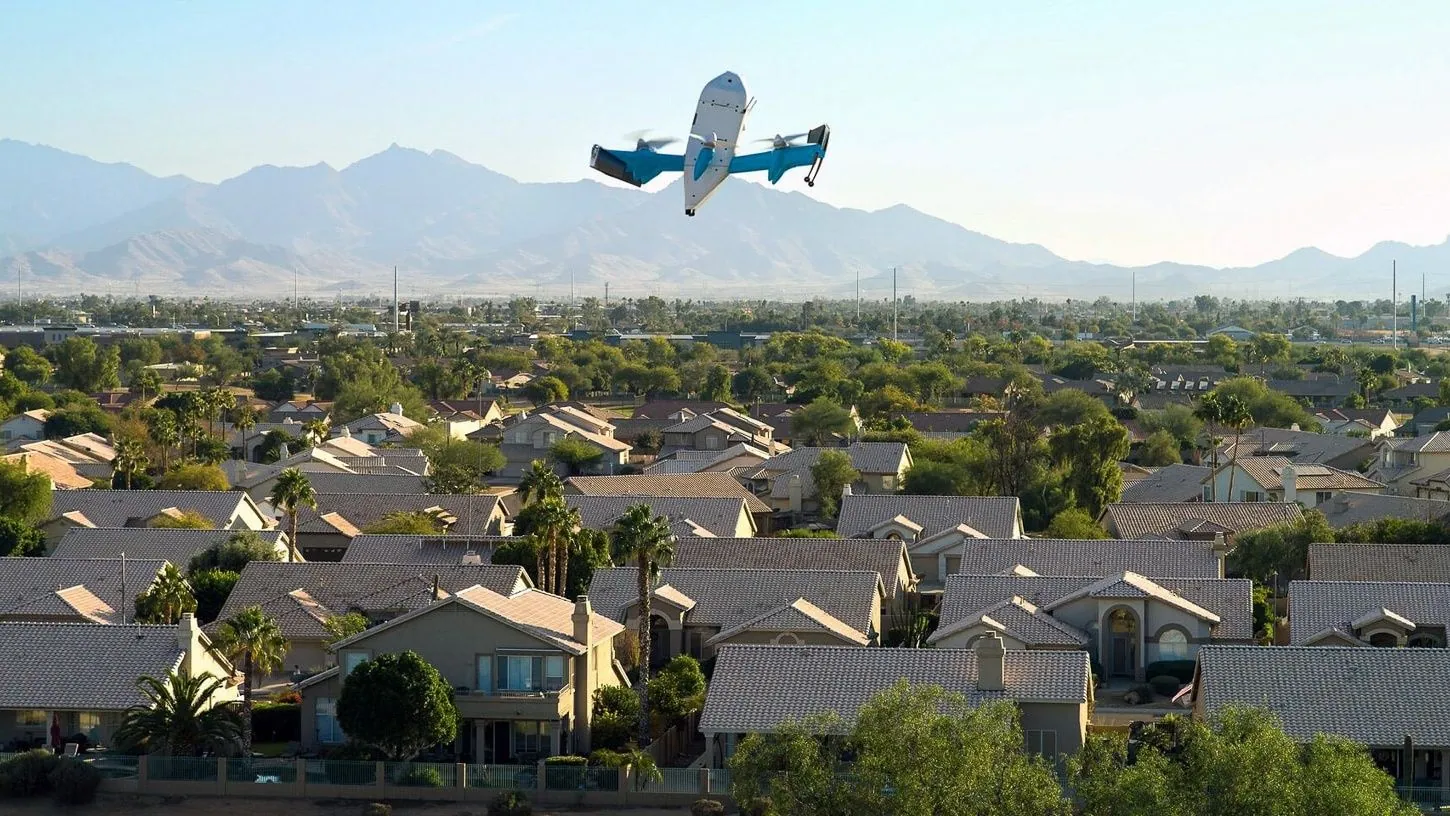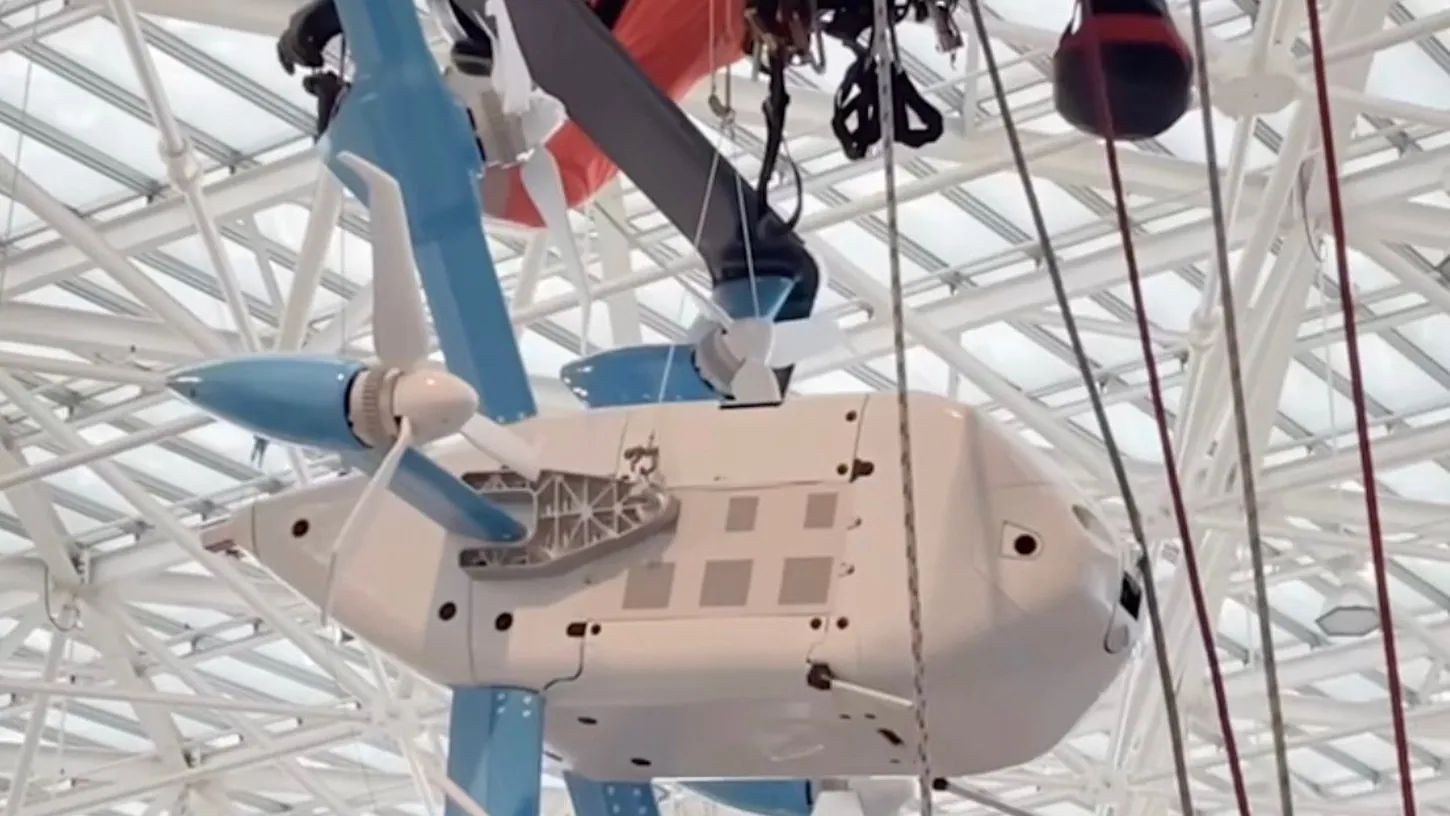
The Museum of Flight in Seattle hung an Amazon Prime Air MK30 delivery drone from the ceiling of its T.A. Wilson Great Gallery this week, the museum said in a LinkedIn post thanking Amazon for the aircraft. The MK30 joins the museum’s Uncrewed Aerial Vehicles exhibit, alongside a German V-1, the Insitu Aerosonde and the Lockheed Martin RQ-3A DarkStar, in a hall whose own page counts 39 full-size historic aircraft. It is also the type Amazon flies to customers today in 13 US metros, by DroneXL’s count, and plans to fly in nearly 500 cities and towns by the end of the year.
The museum’s post describes a drone built to carry packages of 5 pounds (2.3 kilograms) or less to Amazon customers in under 30 minutes, with obstacle detection and flight in “extreme cold and heat.” DroneXL’s Drone Delivery Tracker lists seven US incidents for the MK30 since December 2024, and none of Amazon’s public environmental filings with the Federal Aviation Administration lists a parachute.
Amazon’s MK30 Went From Rendering to Museum Ceiling in Four Years
Amazon showed the MK30 as a rendering in November 2022 and as a finished aircraft in October 2023, and says the FAA cleared it for beyond-visual-line-of-sight flights in October 2024. As of November 8, neither the museum’s post nor Amazon’s newsroom says whether the Seattle airframe flew a delivery.
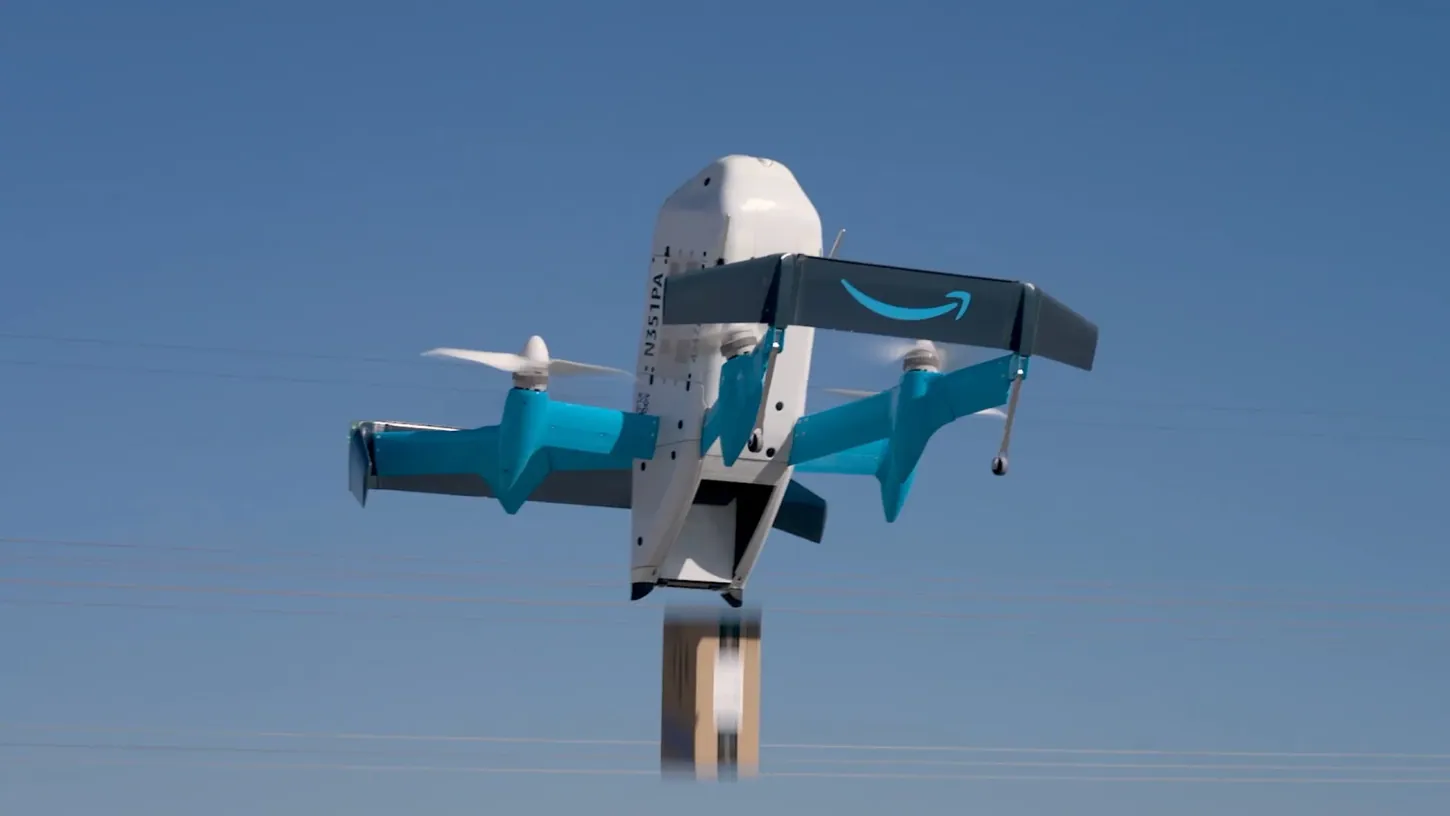
Amazon’s FAA filings describe a six-motor aircraft that takes off vertically, cruises on a wing, descends to 13 feet (4 meters) over a yard and drops the package through doors in its belly. It weighs 77.9 pounds (35.5 kilograms) empty and 83.2 pounds (37.8 kilograms) at takeoff with its 5-pound cargo, figures the FAA carries in its national environmental assessment for drone delivery, and none of Amazon’s public environmental filings lists a parachute or other recovery system. Amazon says the MK30 has a fully redundant system for all safety-critical features, including a separate monitoring computer. Amazon’s own 2022 reveal promised increased range, expanded temperature tolerance and flight in light rain, and its 2023 page says the MK30 flies twice as far as previous models, cuts perceived noise by almost half, and detects and avoids people, pets and property. Neither Amazon page gives a temperature range in degrees, and DroneXL found none in Amazon’s newsroom or its public FAA filings on November 8. In May 2024, Calsee Hendrickson, then a director of product and program management for Prime Air, said the Tolleson, Arizona, operation would not take orders above 104°F (40°C).

Amazon’s earlier museum drone was a different aircraft. In August 2018 the Smithsonian’s National Air and Space Museum said it would display an Amazon Prime Air hybrid drone, a demonstration model, in its We All Fly gallery, and Amazon drove it 2,700 miles to the Udvar-Hazy Center in Chantilly, Virginia. The MK30 in Seattle is the aircraft Amazon has flown to customers since November 2024 and is still building its network on.
Seven MK30 Incidents Sit on DroneXL’s Record Through September 2026
The tracker’s seven US incidents run from December 2024 to September 11, 2026. They include a crash at Amazon’s Pendleton, Oregon, test range. Two drones hit a crane in Tolleson on October 1, 2025, and one made a precautionary landing in Baton Rouge on September 11.
The Tolleson crane strikes paused Prime Air for the second time in 2025 and drew investigations from the National Transportation Safety Board and the FAA. Ten days after Baton Rouge, another MK30 set itself down on a Waco lawn, wheels out, and as of DroneXL’s last reports Amazon had not said what triggered either landing. Amazon has also not explained the absence of a parachute since DroneXL asked for an engineer on the record at Commercial UAV Expo in September and published its questions on September 6. Zipline’s P2, the aircraft DroneXL measures delivery drones against, weighs 55 pounds (25 kilograms) empty and 63 pounds (29 kilograms) at takeoff, carries 8 pounds (3.6 kilograms), lowers the package on a tether from 300 feet (91 meters) and carries a parachute it has deployed twice over Texas.
Amazon Added Nampa as Its 13th Metro in October and Claims a UK First Now
Amazon began MK30 deliveries in Nampa, Idaho, on October 30, and the FAA’s environmental index carried no Idaho document when DroneXL checked it on November 2. Markham has flown since October while the FAA’s Chicago environmental review remains a draft, and Tallahassee is due in mid-November.
The expansion is drawing resistance as it goes. Fifteen states sued the FAA in September over the nationwide environmental clearance Amazon’s newest hubs run on, and on November 2 Westborough’s building commissioner withdrew the zoning ruling behind Amazon’s planned pad in Massachusetts. Residents under a new 7.5-mile (12-kilometer) circle who want to reach Amazon can call 1-888-280-4331 or use the customer service chat, choosing “Something Else” and then “Amazon Drone Delivery”; DroneXL’s guide for residents covers both and what a town can still do.
None of those circles is in Washington. Amazon is headquartered in Seattle, and neither its FAA filings nor DroneXL’s tracker shows a Prime Air hub anywhere in the state. Wing named Seattle for 2027 in its October Walmart expansion, and Zipline has proposed up to 75 sites around the city, a plan still in FAA review.
In the UK, David Carbon, Amazon’s vice president of Prime Air, said on LinkedIn on November 7 that Prime Air had received what he called the world’s first SAIL IV operating authorization and flight worthiness validation from the Civil Aviation Authority. “This is a genuine global first,” Carbon wrote. SAIL, the Specific Assurance and Integrity Level, is the risk tier a drone operation is assigned under the SORA framework that European and UK regulators use, and Carbon described level IV as one of the highest levels of operational and safety assurance in drone aviation. The CAA’s newsroom carried no matching announcement when DroneXL checked it on November 8, and Carbon’s post names no site, document or flight cap. Amazon’s only UK operation, in Darlington, has flown since May under a trial permission that expires at the end of 2026. Carbon also wrote that Prime Air would pass a run rate of 4 million deliveries a year by the end of this year.
DroneXL’s Take
I’m fine with the MK30 in a museum. It is a serious piece of engineering, and a Seattle schoolkid looking up at it under the same roof as a V-1 and a DarkStar should see what the city’s best-known company built. My quarrel is with the label, if it reads like the museum’s post, which so far repeats Amazon’s pitch. The facts that matter to anyone living under a Prime Air circle are the ones in the filings: 83 pounds at takeoff carrying 5 pounds of cargo, a 13-foot drop, and no parachute or other recovery system in any public filing. I’m for drone delivery when the cargo justifies the flight, and a shoebox from a warehouse does not justify that aircraft over a backyard in Nampa or Markham when Zipline has shown that a lighter drone with a parachute does the job. If the museum wants the exhibit to teach something about delivery drones, the weight, the payload and the missing parachute belong on the placard next to Amazon’s 30-minute promise.
Sources: The Museum of Flight, Museum of Flight exhibit page, Amazon, FAA, Smithsonian National Air and Space Museum, David Carbon on LinkedIn
DroneXL uses automated tools to support research and source retrieval. All reporting and editorial perspectives are by Haye Kesteloo. Read our editorial standards.