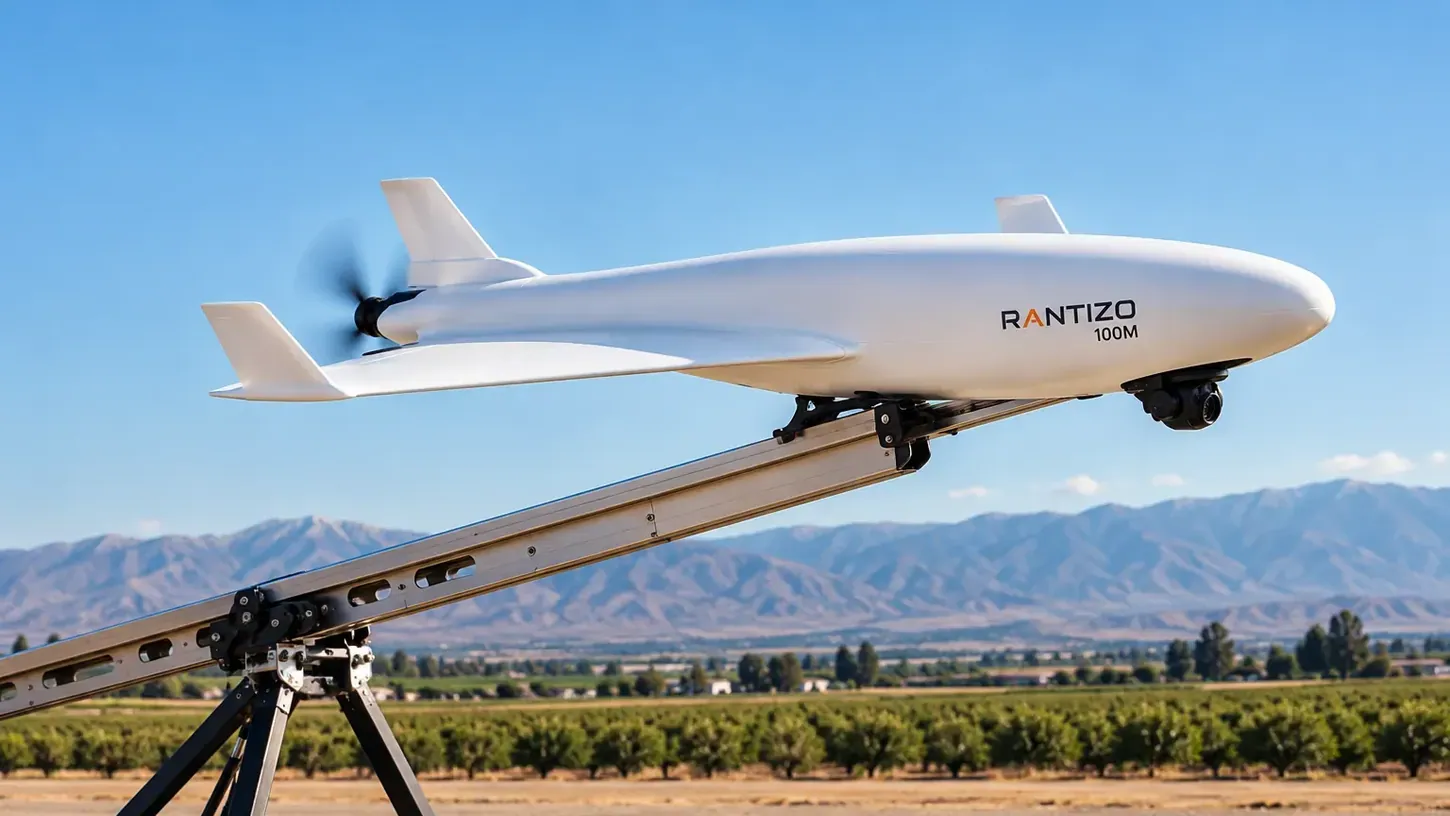
Rantizo, the Houston drone company that started trading on Nasdaq as RNTZ on October 13, unveiled a prototype fixed-wing surveillance drone on October 28. The release lists border security first among five uses for the battery-powered aircraft. Rantizo expects it on sale in mid-2027, after testing.
The release gives the prototype two different range targets. Its spec table lists “GPS / LORAN” for navigation, and the US Coast Guard began shutting down its LORAN-C network in 2010.
A Singapore Utility Contractor Took Rantizo Public
Rantizo reached Nasdaq through SKK Holdings, a Cayman Islands company whose subsidiaries lay cables and water pipes underground in Singapore. SKK bought Rantizo, Inc.’s drone assets for about $258.8 million, mostly in new shares, in a deal that closed October 12 and switched the ticker to RNTZ.
SKK had listed in October 2024 with a $10 million IPO at $4 a share. Under SKK’s closing announcement, Rantizo, Inc. received 51,966,591 new Class A shares and owns about 87% of that class after closing. Certain individuals were granted management shares valued at $12 million, and both blocks of shares are locked up for six months. Rantizo’s homepage names the Harvest 100 spray drone and the Titan fire and forestry drone. It says the company holds FAA authorization in more than 15 states and counts Nutrien and Helena as distribution partners.
The name has changed hands before. Rantizo, an Iowa City startup, won FAA approval to spray crops by drone in 2019. In August 2025 it sold its spraying business to an unnamed investment group that kept the Rantizo name, and the original company became software maker American Autonomy. The Rantizo, Inc. that sold its assets to SKK is a Delaware corporation headquartered in Houston. Neither Rantizo’s October releases nor its website say whether it is the group that bought the Iowa business. Marianne McInerney became president of the listed company at closing.
Rantizo’s Release Gives One Prototype Two Range Targets
Rantizo’s release text gives a targeted range of “up to 130 miles” (209 km). Its spec table lists “150 miles >” (241 km). Other targets include a 75 mph (121 km/h) top speed, a 43.4 mph (70 km/h) cruise and a ceiling above 12,000 feet (3,658 m).
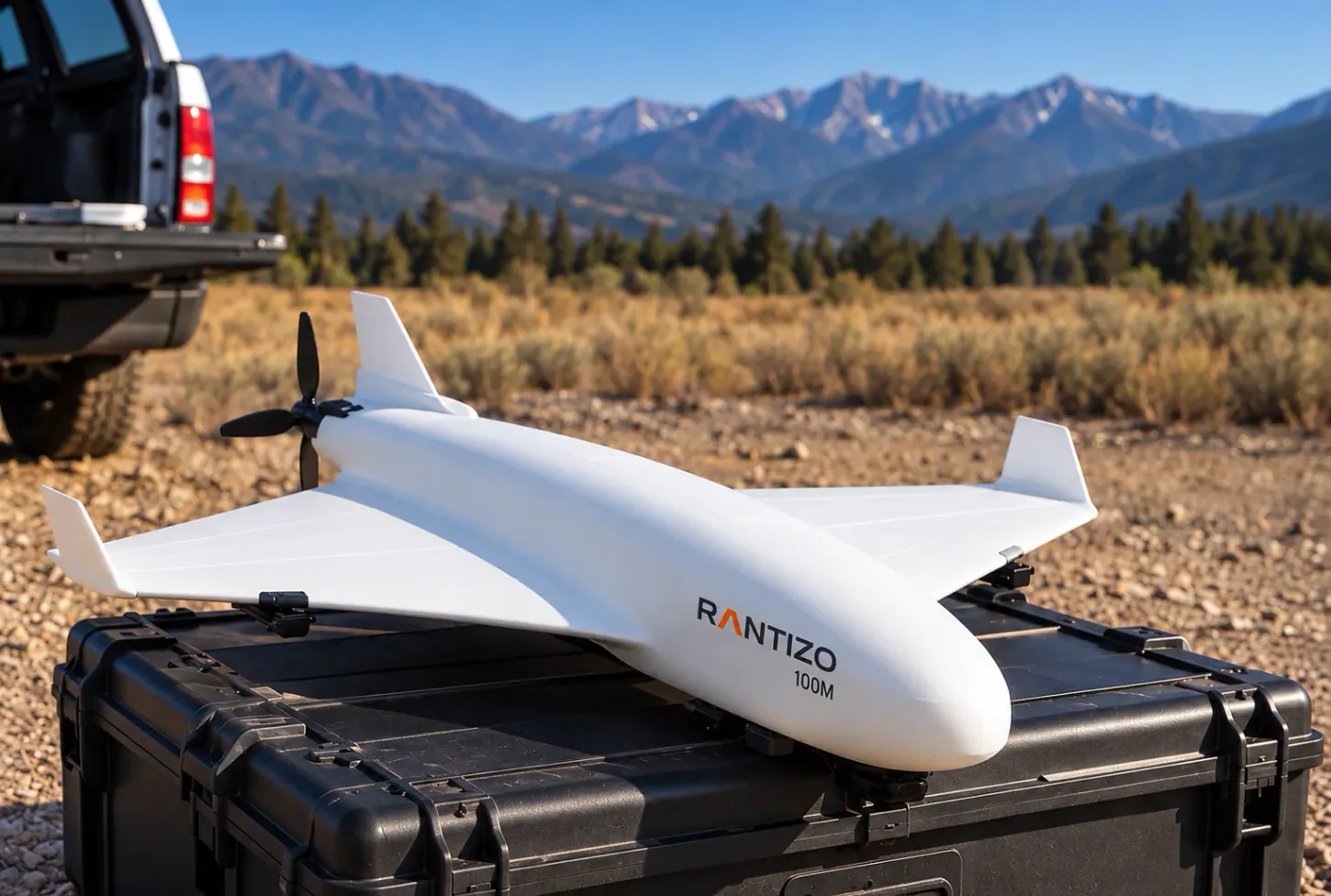
The release says the specifications “are subject to change as testing progresses.” Flown at the stated cruise, 130 miles would take about three hours and 150 miles about three and a half. The release gives no endurance figure or battery capacity to check either number against. Rantizo calls the airframe compact, with a 43.9-inch (112 cm) wingspan, a 45.4-inch (115 cm) fuselage and more than 4 pounds (1.8 kg) of payload. It says the drone carries a camera with target recognition and lists its detection profile as “Low,” without saying what that is measured against.
Rantizo’s fixed-wing page, checked October 29, calls the aircraft “long-range” but has no range figure in its spec sheet. Its list of applications does not include border security, the mission the release leads with. A graphic on the page is labeled “targets, not flight data.” The images there show the aircraft marked “100M,” a designation the release never uses, and six of them lined up on a table.
The Coast Guard Switched Off LORAN-C in 2010
LORAN-C was the land-based radio navigation network the US Coast Guard ran for decades, until the White House declared it obsolete in May 2009. Congress allowed its termination that October, and the Coast Guard began shutting it down in February 2010, according to the federal GPS program’s LORAN-C history.
The Coast Guard Authorization Act of 2015 later let the Coast Guard partner on a GPS backup that “may consist of an enhanced LORAN system.” Rantizo’s release lists “GPS / LORAN” for navigation and stops there. It doesn’t say which LORAN signal the drone would receive or where one is broadcasting for it. A working GPS backup would be a strong selling point on a border surveillance drone. In New Mexico, military GPS jamming at White Sands was active when a medevac crew flew into a mountain.
DroneXL’s Take
I want this kind of company to win. After the FCC barred new foreign-made drones last December, American farmers and fire crews need US-built aircraft, which is the pitch on Rantizo’s own homepage. A surveillance drone pitched to government buyers lives or dies on its numbers, though, and this one arrived with two range targets and a spec table that lists LORAN, a signal the US stopped broadcasting 16 years ago. Two weeks into life as a public company, Rantizo is showing this aircraft with what its own page calls targets, not flight data. If I were a sheriff or a Border Patrol sector buying in 2027, I’d ask Rantizo for one flight log showing the drone covering 130 miles on a single battery, and for the LORAN signal it would use.
Sources: GlobeNewswire (Rantizo release), Rantizo fixed-wing product page, SKK closing announcement, IPOScoop, GPS.gov LORAN-C history, Iowa Farm Bureau, Precision Farming Dealer
DroneXL uses automated tools to support research and source retrieval. All reporting and editorial perspectives are by Haye Kesteloo. Read our editorial standards.