House Homeland Security Chair Calls Drones a “New, Growing Frontier” of Threats to U.S. Critical Infrastructure

Check out the Best Deals on Amazon for DJI Drones today!
The same week DHS announced its permanent counter-drone office and FEMA began distributing $500 million in C-UAS grants, the House Homeland Security Committee held an oversight hearing that spelled out exactly why the federal government is treating drones as a top-tier threat. Chairman Andrew R. Garbarino’s opening statement placed drones alongside cyberattacks and AI-enabled operations as the threats keeping federal officials up at night.
“The potential for coordinated attacks using drones to disrupt flights or deliver explosives represents a new, and growing, frontier of security threats,” Garbarino said during the January 21 hearing titled “Oversight of the Department of Homeland Security: CISA, TSA, S&T.”
The hearing examined how CISA, TSA, and the Science and Technology Directorate are confronting what Garbarino called an increasingly complex and dangerous threat environment. Witnesses included Madhu Gottumukkala, acting CISA director; Ha Nguyen McNeill, senior official performing TSA administrator duties; and Pedro Allende, under secretary for the Science and Technology Directorate.
Garbarino’s statement connects drones to broader infrastructure vulnerability
The Trump administration’s drone policy has operated on two parallel tracks since June 2025: expanding commercial drone operations while simultaneously building counter-drone infrastructure at an unprecedented scale. Garbarino’s testimony demonstrates how congressional leadership views these parallel tracks as complementary rather than contradictory.
“Over the past two decades, threats facing our nation’s aviation, transportation, and critical infrastructure have only risen,” Garbarino stated. “Today’s risks are far more diverse, complex, and technologically advanced, and the motivations and methods of our adversaries have shifted rapidly with emerging technologies.”
The chairman specifically noted that traditional terror tactics have given way to more sophisticated methods of attack, with cybersecurity now at the forefront of these conversations. He identified adversaries attempting to take down transportation systems through digital means as a primary concern, but the drone threat received equal billing.
This hearing arrives at a significant moment. The SAFER SKIES Act became law through the FY 2026 NDAA just last month, creating the first federal framework allowing state and local police to disable drones at stadiums and critical infrastructure. FEMA’s $500 million C-UAS grant program launched in early January. And the DHS Program Executive Office for Counter-UAS was announced on January 12, formalizing what had been scattered counter-drone operations across multiple agencies.
CISA’s mission-first reset prioritizes cyber-physical risks
Acting CISA Director Gottumukkala outlined his agency’s refocused priorities in written testimony, emphasizing the intersection between cyber threats and physical infrastructure. CISA has launched targeted initiatives to close risk gaps particularly where cyber threats intersect with real-world consequences.
“We are prioritizing what works from previous lessons learned, eliminating duplication, and ensuring every new service or product we release directly advances CISA’s statutory mission and responsibilities,” Gottumukkala stated.
This language mirrors the concerns we documented when the FBI and CISA issued joint warnings about Chinese drones in January 2024. That guidance identified Chinese-manufactured drones as a “significant risk” to U.S. critical infrastructure, citing data security concerns stemming from legal authority granted to the Chinese government to access data held by Chinese companies.
Gottumukkala confirmed CISA has scaled its Endpoint Detection and Response technology, giving analysts near real-time visibility to detect and stop advanced threats. The agency is also reviewing public comments on the proposed rule for CIRCIA (Cyber Incident Reporting and Critical Infrastructure Act of 2022), with the final rule process nearing completion.
For 2026, CISA plans to right-size and rebalance its workforce by prioritizing highly technical professionals in mission-critical roles, including cybersecurity operators and infrastructure security experts. Gottumukkala emphasized these targeted positions will support frontline critical infrastructure owners and operators across every region.
The drone threat context: European airport chaos and domestic incidents
Garbarino’s characterization of drones as a “new, and growing, frontier” arrives after a year of documented incidents that validate the concern. Just last week, a suspected drone disrupted flights at London Heathrow. In October, military reconnaissance drones shut down Munich Airport twice in two days. A classified German security report confirmed the aircraft were military-grade surveillance platforms, not hobbyist quadcopters.
The September closure of Copenhagen and Oslo airports demonstrated how coordinated drone operations could paralyze major transportation hubs. Danish Prime Minister Mette Frederiksen called those incidents “the most serious attack on Danish critical infrastructure to date” and suggested Russia could be behind the disruption.
Domestically, the data tells a similar story. In June 2025, House Republicans demanded action after 350 unauthorized drone incursions over U.S. military bases in 2024. The NFL documented over 2,000 drone incursions per season for each of the last three years. Stadium drone incidents jumped from 67 in 2018 to 2,845 in 2023, according to NFL testimony before Congress.
Even counter-drone technology has created problems. In April 2025, Secret Service counter-drone equipment triggered erroneous air traffic alerts at Reagan National Airport, sparking congressional concern about coordination between security imperatives and aviation protocols.
The signal jamming problem amplifies infrastructure vulnerability
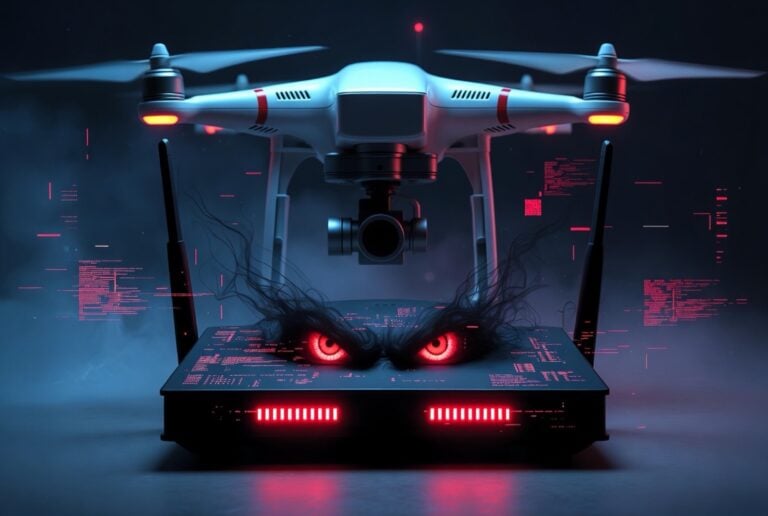
Garbarino’s testimony also touched on adversaries’ ability to take down transportation systems through digital means. This threat intersects directly with the drone landscape through signal jamming. In June 2025, DHS issued a warning that Chinese-made signal jammers smuggled into the U.S. had increased 830% since 2021. These devices pose direct threats to police and first responder drones that rely on stable GPS and radio signals to operate effectively.
DHS documented instances where criminals, including illegal aliens, used jammers to interfere with police communications during crimes like home invasions and bank robberies in Florida, Texas, and Virginia. The dual-use threat of signal jammers affecting both drone operations and broader communications infrastructure represents exactly the kind of cyber-physical convergence Garbarino identified.
DroneXL’s Take
Garbarino’s testimony is the clearest signal yet that congressional leadership views drones as a fundamental threat vector rather than a peripheral concern. The timing is not coincidental. This hearing arrived ten days after DHS announced its permanent counter-drone office and three weeks after the SAFER SKIES Act became law.
I have been tracking the counter-drone buildup since October, and the pattern is unmistakable. Legal authority through SAFER SKIES. Funding through FEMA grants. Training through the FBI’s National Counter UAS Training Center. Permanent coordination through the new DHS Program Executive Office. Each piece reinforces the others.
What strikes me about Garbarino’s statement is the specificity. He did not say drones “could potentially” disrupt flights or “might theoretically” deliver explosives. He said coordinated drone attacks on aviation and infrastructure represent an active, growing threat. That language reflects the classified briefings congressional leaders receive about documented incidents that never make public reports.
For recreational and commercial pilots, the message is clear. The airspace around critical infrastructure, stadiums, and major events is getting more hazardous. Not because of new threats to pilots, but because the federal response to drone threats is expanding at every level. Once thousands of state and local officers complete FBI counter-drone training and receive FEMA-funded mitigation equipment, the pressure to use those capabilities beyond their original scope will be significant.
Expect more hearings like this one in 2026. The World Cup security framework is driving immediate action, but the infrastructure being built will outlast the tournament by decades. My six-month prediction: by July 2026, every major metropolitan area in America will have some form of active counter-drone capability, and the legislative push to expand that authority to wildfire operations, border security, and general critical infrastructure protection will intensify.
Editorial Note: AI tools were used to assist with research and archive retrieval for this article. All reporting, analysis, and editorial perspectives are by Haye Kesteloo.
Discover more from DroneXL.co
Subscribe to get the latest posts sent to your email.
Check out our Classic Line of T-Shirts, Polos, Hoodies and more in our new store today!

MAKE YOUR VOICE HEARD
Proposed legislation threatens your ability to use drones for fun, work, and safety. The Drone Advocacy Alliance is fighting to ensure your voice is heard in these critical policy discussions.Join us and tell your elected officials to protect your right to fly.

Get your Part 107 Certificate
Pass the Part 107 test and take to the skies with the Pilot Institute. We have helped thousands of people become airplane and commercial drone pilots. Our courses are designed by industry experts to help you pass FAA tests and achieve your dreams.

Copyright © DroneXL.co 2026. All rights reserved. The content, images, and intellectual property on this website are protected by copyright law. Reproduction or distribution of any material without prior written permission from DroneXL.co is strictly prohibited. For permissions and inquiries, please contact us first. DroneXL.co is a proud partner of the Drone Advocacy Alliance. Be sure to check out DroneXL's sister site, EVXL.co, for all the latest news on electric vehicles.
FTC: DroneXL.co is an Amazon Associate and uses affiliate links that can generate income from qualifying purchases. We do not sell, share, rent out, or spam your email.