Michigan’s 15-Bill SHIELD Drone Package Collides With Federal Law It Claims to Respect

Check out the Best Deals on Amazon for DJI Drones today!
Michigan legislators just introduced the most ambitious state drone regulation package in the country. It also has the most obvious federal preemption problems of any state drone package in the country. The 15-bill SHIELD legislation, sponsored by state Rep. William Bruck (R-Erie), received its first committee hearing this week and would create “no drone zones” over critical infrastructure, authorize police to take down drones, mandate a state-run geofencing app, and ban drones from “companies of concern.” It would also cost Michigan taxpayers up to $60 million to implement.
Here is what you need to know:
- The Development: Michigan’s SHIELD (Securing Homeland and Infrastructure with Emerging Laws for Drones) package contains 15 bipartisan bills that would regulate drone flights over state-owned property and critical infrastructure, authorize police drone takedowns, require a mandatory smartphone app for all drone operators, and ban drones made by federally designated companies of concern.
- The Problem: Multiple provisions directly regulate airspace and flight operations, areas where the FAA has exclusive authority under federal law. Michigan’s own Aeronautics Commission Chair has warned the package could “co-mingle federal and state authority” and create a patchwork that makes flying less safe, not safer.
- The Timing: This package arrives weeks after the federal SAFER SKIES Act already gave state and local law enforcement counter-drone authority at sporting events and mass gatherings, and after the FCC already banned all foreign-made drones from receiving new equipment authorizations.
SHIELD covers 15 bills and targets everything from flights to purchases
Michigan’s SHIELD package is a 15-bill legislative effort that would change how the state regulates drone usage, covering everything from where drones can fly to which drones state agencies can buy. House Bill 5319, the lead bill, would designate correctional facilities, law enforcement buildings, and critical infrastructure as “no drone zones.” Critical infrastructure includes power plants, railroads, data centers, and battery storage facilities, as identified by the state or by the federal Cybersecurity and Infrastructure Security Agency (CISA).
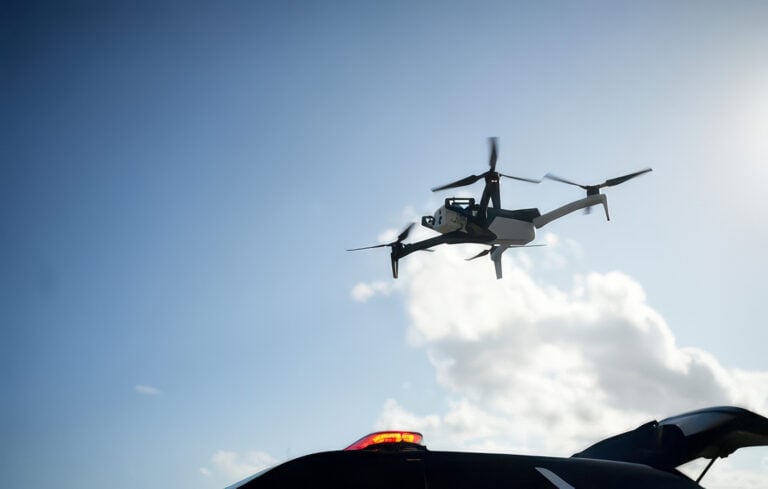
Additional bills in the package would allow police and authorized private security to disable drones that violate the law or pose a public safety risk. Other legislation would create a state standard for “no drone zone” signs, prohibit drones from trespassing over private property to invade privacy or harass residents, and ban state and local governments and universities from purchasing drones made by “federally-designated companies of concern.” That purchasing ban kicks in after two years, with an operational ban after five.
Violators could face a four-year felony and fines up to $2,500, though Bruck has acknowledged a substitute bill would include lighter penalties for first-time, non-malicious offenders.
Bruck used data from Airspace Link’s AirHub Portal during the committee hearing to show dozens of drone flights around downtown Detroit and near the Canadian border over just a few days. He also referenced Ukraine’s “Operation Spiderweb” drone strike on Russian strategic bombers and the Thomas Crooks assassination attempt drone reconnaissance at the Butler, Pennsylvania Trump rally as examples of drone threats.
The $60 million geofencing mandate duplicates what already exists
The SHIELD package requires the Michigan Department of Transportation (MDOT) to purchase, develop, or contract a smartphone app that every drone operator in the state must use while flying. The app would warn operators when they approach a restricted zone. A separate bill requires MDOT to create and maintain a publicly accessible state geofencing database listing all restricted zones.
MDOT’s cost estimate for this system: $20 to $40 million for sensors, $10 to $20 million for IT infrastructure, and four to 10 additional staff members. The Michigan Drone Association’s Matt Rybar called it an unfunded mandate.
The irony is hard to miss. The FAA already operates the Low Altitude Authorization and Notification Capability (LAANC) system, which provides automated airspace authorizations through apps like Aloft, Airspace Link, and others. The FAA’s B4UFLY app already warns pilots about restricted airspace. And DJI, which makes the majority of drones flown in the United States, removed its own geofencing restrictions in January 2025 specifically because, as DJI’s head of global policy Adam Welsh explained, the manufacturer’s geofencing system was never required by any regulatory agency and created operational conflicts with FAA-authorized flights.
Michigan is proposing to spend tens of millions of dollars building what DJI just dismantled because it was creating problems for legal drone operators. The state wants to create a geofencing database that would run parallel to, and potentially conflict with, the FAA’s own airspace data. That is a recipe for the exact kind of operational confusion the Michigan Aeronautics Commission warned about.
Federal preemption is the legal wall this package will hit
The FAA has exclusive authority over U.S. airspace from the ground up. This is not a gray area. As the FAA stated in its 2023 updated fact sheet on state and local drone regulation, Congress has “vested the FAA with broad and exclusive legal authority to regulate airspace use, management, safety, and more.” States can regulate land use, privacy issues through existing tort law, and where drones take off and land. They cannot regulate flight paths, altitudes, or airspace access.
Multiple SHIELD provisions step directly into FAA territory. Creating “no drone zones” over specific facilities is airspace regulation. Authorizing police to disable drones in flight is interference with aircraft operations. Requiring a state app for all drone operations is regulating the conduct of flight. These are the same federal preemption issues we have covered when Wisconsin proposed letting police shoot down drones, when Montgomery County, New York banned flights over government buildings, and when Connecticut passed altitude restrictions near harbors.
Michigan knows this better than most states. The state’s own Court of Appeals ruled in 2022 that local governments cannot make or enforce their own drone laws due to the state’s preemption statute (MCL 259.305). That decision was hailed as a model for preventing the “patchwork quilt” of conflicting local regulations that former FAA Administrator Michael Huerta warned would make national airspace less safe. Michigan was the example other states should follow. Now the state legislature wants to create state-level restrictions that run into the same preemption doctrine at the federal level.
Benjamin Carter, Chair of the Michigan Aeronautics Commission, put it directly in written testimony to the committee: the package could “drive unsafe use of drones” by “co-mingling federal and state authority and by creating a patchwork of restrictions” that cause uncertainty for pilots.
The SAFER SKIES Act already addressed counter-drone authority
Michigan’s push to authorize police drone takedowns comes just weeks after the federal government already addressed this issue. The SAFER SKIES Act, passed in the FY 2026 NDAA and signed by President Trump on December 18, 2025, created the first federal framework allowing state, local, and tribal law enforcement to detect, track, and disable drones that pose a “credible threat” at sporting events and critical infrastructure.
Officers who complete training at the FBI’s new National Counter UAS Training Center in Huntsville, Alabama earn authorization to conduct counter-drone operations under federal supervision. The DHS just created a permanent Program Executive Office to coordinate these operations nationwide. And FEMA is distributing $500 million in grants for counter-drone detection equipment, with a condition that participating agencies must have officers trained at the FBI center.
Michigan is already part of this federal framework. The FBI partnered with Michigan agencies on drone enforcement near Detroit Metropolitan Airport in October 2025, a collaboration that could serve as a model for federal-state coordination. The state invested $24.5 million between 2023 and 2024 in drone infrastructure.
The question the SHIELD sponsors have not answered: why does Michigan need to create its own counter-drone authority when federal law just established exactly that? The legal path for police to take down threatening drones now runs through federal training and authorization. State legislation authorizing the same activity without federal coordination faces the same legal challenges that killed similar efforts in other states.
Amazon is delivering packages by drone in Michigan right now
The SHIELD package includes exemptions for commercial drone operators and public safety agencies. Those exemptions will be tested immediately, because Amazon launched Prime Air drone delivery in Pontiac, Michigan in November 2025 and expanded to Hazel Park weeks later. Amazon now operates two drone delivery facilities in metro Detroit, flying MK30 drones within a 7.5-mile radius of each site.
Grand Rapids-based Westwood AI actually praised the legislation in written testimony, arguing it creates “certainty and sustainability required for investment.” But the Michigan Drone Association, representing over 800 individual members and 140 member groups, took a more cautious position. Representative Matt Rybar said the key is distinguishing between negligent and malicious flying in penalty structures and maintaining equitable airspace access.
That distinction matters. A four-year felony for a recreational pilot who accidentally flies over a water treatment plant and a four-year felony for someone intentionally conducting surveillance on a prison are not the same offense. The penalty structure in these bills, even with the promised substitute for first-time offenders, treats them as if they are.
The “companies of concern” ban mirrors what the FCC already did
The SHIELD package would prohibit state and local governments, colleges, and universities from buying drones made by “federally-designated companies of concern,” with a two-year purchase deadline and five-year operational deadline. This is almost certainly aimed at DJI and other Chinese manufacturers.
The timing makes this provision largely redundant. The FCC added all foreign-made drones and critical components to its Covered List on December 22, 2025, blocking new FCC equipment authorizations. New DJI models will not be available in the U.S. for the foreseeable future. Michigan’s state-level ban adds a layer of regulation on top of a federal action that already accomplished the same goal.
The five-year operational ban is more aggressive than federal action to date and raises questions about how agencies that rely on DJI drones for search and rescue, fire response, and law enforcement operations will replace their fleets. Michigan law enforcement agencies have been using drones extensively. In February 2025, an Oscoda Township police DJI Air 3 was shot down during a standoff, illustrating both the operational reliance on DJI hardware and the real-world drone threats police already face.
Michigan’s drone legal history makes this package even more complicated
Michigan has one of the most active drone legal environments in the country. The state court system has grappled with warrantless drone surveillance in zoning cases, the Michigan Supreme Court has sidestepped the drone privacy question, and the University of Michigan faces an ongoing lawsuit over its drone ban from the Michigan Coalition of Drone Operators. That same coalition won the 2022 ruling that prevented local governments from making their own drone ordinances.
The SHIELD package would reshape this entire legal framework. It would give the state authority that courts have said local governments cannot exercise. It would create criminal penalties for activities that may be protected under federal aviation law. And it would build enforcement infrastructure that may conflict with the federal counter-drone framework already being deployed.
The bills will go through a series of three hearings. No votes have been taken yet. Bruck himself acknowledged the package is not perfect, telling the committee: “There’s much more to do, but we must do something.”
DroneXL’s Take
I have been covering state drone legislation for years, and the pattern is always the same. A state legislator sees a scary drone headline, hears a constituent complaint, watches a combat clip from Ukraine, and decides to “do something.” That impulse is understandable. The legislation it produces is almost always legally vulnerable.
Michigan’s SHIELD package has real ambition. Fifteen bills, bipartisan sponsorship, stakeholder engagement over more than a year. Bruck clearly did more homework than most state legislators who touch drone policy. But ambition does not fix federal preemption. The FAA’s authority over airspace is not negotiable, and no amount of state-level “no drone zone” signage changes that legal reality.
What frustrates me about packages like this is that Michigan has a legal path that actually works. The state is already partnering with the FBI on drone enforcement near Detroit Metro. The SAFER SKIES Act just gave Michigan law enforcement the federal authorization they need to act on drone threats at major events. FEMA grants are available to fund the equipment. The FBI training center is graduating officers. All of these federal programs exist specifically so states do not have to reinvent the wheel and create conflicting legal frameworks.
The $20 to $40 million geofencing database is the most telling provision. Michigan wants to build a state-run airspace restriction system that will inevitably conflict with FAA data, confuse pilots juggling multiple mandatory apps, and cost taxpayers tens of millions to maintain. The FAA already provides this data for free through LAANC. DJI already integrates FAA data into its flight apps. Michigan is proposing to spend a fortune solving a problem that the federal government already solved.
My prediction: the counter-drone and geofencing provisions will either be stripped out or rewritten to align with federal authority before this package reaches a floor vote. The “companies of concern” purchasing ban and the privacy protections around private property have the best chance of surviving, because those fall within what states can legally regulate. The four-year felony penalty will be reduced for recreational pilots after the Michigan Drone Association’s 800 members make themselves heard.
Bruck said Michigan cannot fight drone threats “with both hands tied behind their backs.” He is right about the threat. He is wrong about the solution. The hands are not tied. The federal government just untied them with the SAFER SKIES Act. Michigan should use those tools instead of building ones that will not survive a legal challenge.
What do you think about Michigan’s SHIELD drone package? Share your thoughts in the comments below.
Editorial Note: AI tools were used to assist with research and archive retrieval for this article. All reporting, analysis, and editorial perspectives are by Haye Kesteloo.
Discover more from DroneXL.co
Subscribe to get the latest posts sent to your email.
Check out our Classic Line of T-Shirts, Polos, Hoodies and more in our new store today!

MAKE YOUR VOICE HEARD
Proposed legislation threatens your ability to use drones for fun, work, and safety. The Drone Advocacy Alliance is fighting to ensure your voice is heard in these critical policy discussions.Join us and tell your elected officials to protect your right to fly.

Get your Part 107 Certificate
Pass the Part 107 test and take to the skies with the Pilot Institute. We have helped thousands of people become airplane and commercial drone pilots. Our courses are designed by industry experts to help you pass FAA tests and achieve your dreams.

Copyright © DroneXL.co 2026. All rights reserved. The content, images, and intellectual property on this website are protected by copyright law. Reproduction or distribution of any material without prior written permission from DroneXL.co is strictly prohibited. For permissions and inquiries, please contact us first. DroneXL.co is a proud partner of the Drone Advocacy Alliance. Be sure to check out DroneXL's sister site, EVXL.co, for all the latest news on electric vehicles.
FTC: DroneXL.co is an Amazon Associate and uses affiliate links that can generate income from qualifying purchases. We do not sell, share, rent out, or spam your email.