Eric Schmidt’s AI Drones Hit 70% Kill Rate as Commercial Tech Goes to War

Check out the Best Deals on Amazon for DJI Drones today!
The drone skills you learned for your Part 107 business are now battlefield capabilities. That’s the uncomfortable reality buried in a massive New York Times investigation published this week, and it should concern every commercial operator in America.
C.J. Chivers spent 18 months reporting from Ukrainian frontlines, test ranges, and drone workshops. What he documented is the industrialization of autonomous drone warfare using the same technology stack that powers civilian operations: visual positioning systems, AI target recognition, computer vision, and yes, Raspberry Pi microcomputers.
Here’s what you need to know:
- What: Former Google CEO Eric Schmidt’s secretive operation has deployed AI-powered attack drones with over 70% autonomous hit rates in Ukraine
- Who: Schmidt’s ventures (White Stork/Project Eagle), NORDA Dynamics, X-Drone, Vermeer, and Sine Engineering are leading development
- Scale: Over 80,000 AI-enhanced weapons deployed: 50,000+ Underdog modules, 30,000+ X-Drone systems
- Why it matters: These weapons use commercial drone components and techniques identical to Part 107 operations
The full NYT investigation runs over 10,000 words. I’ve extracted what matters for our community.
From Hollywood to Kill Chain: The Vermeer Story
Brian Streem’s journey tells you everything about how commercial drone expertise becomes weapons capability.
In 2018, Streem was running Aerobo, a drone cinematography company that shot aerial footage for Spider-Man: Homecoming, A Quiet Place, True Detective, and Cardi B music videos. He found Hollywood work stressful and the technology limiting. “If you think military drone missions are hard, try making Steven Spielberg happy,” he told Chivers.
By 2019, he was pitching the Air Force at an investor event in Buffalo. By 2024, he was riding a train from Warsaw to Kyiv with navigation modules. Today, his company Vermeer assembles the VPS-212, a GPS-independent visual positioning system, in an office beside a bagel shop in Brooklyn.
The module weighs roughly one pound, contains two cameras and a minicomputer, and can fix a weapon’s location at speeds up to 218 mph. It cannot be jammed or spoofed because it neither emits nor receives signals. By summer 2025, Vermeer technicians were attaching these modules to Ukrainian deep-strike drones hitting targets inside Russia.
Vermeer raised $12 million in recent funding from Draper Associates. The Pentagon has proposed attaching Vermeer’s V.P.S. to new fleets of deep-strike drones. The U.S. Air Force contracted the company to develop an AI-enabled celestial navigation system for precision flight above clouds or over water.
This is the trajectory: commercial cinematography skills to licensed arms dealer in six years.
The Specs: What Schmidt’s Bumblebee Actually Does
We’ve been tracking Eric Schmidt’s drone ventures since January 2024. The NYT piece finally provides concrete operational details.
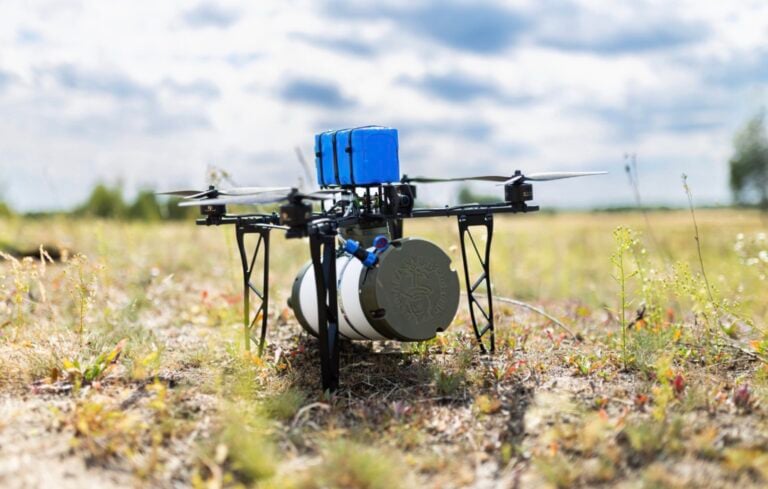
Schmidt’s operation has cycled through multiple names: White Stork, Project Eagle, Swift Beat. According to a sales pamphlet Chivers obtained, the Bumblebee quadcopter claims:
- Over 70% direct-hit rate via autonomous terminal guidance
- Autonomous target recognition that highlights foot soldiers, bunkers, vehicles, and aerial drones before human pilots spot them
- Jam-resistant navigation using visual inertial odometry and redundant communications
- Internet-based control allowing pilots to operate from anywhere with Wi-Fi or broadband
By spring 2025, Bumblebees launched from Ukrainian positions had carried out more than 1,000 combat flights against Russian targets. Pilots say they’ve flown thousands more since.
In January 2025, an autonomous Bumblebee attack stopped a Russian logistics truck driving behind enemy lines. In April, two Bumblebees destroyed a Russian armored vehicle covered with anti-drone protective measures. The vehicle absorbed the first strike and kept moving. The second Bumblebee immobilized it. A vehicle with every protective countermeasure Russia could deploy was removed from action.
Russian soldiers outside Kupiansk and Kharkiv reported these strange new drones seemed impervious to jamming. “The only sure way to stop them was to shoot them down,” according to Chivers.
Schmidt has also deployed the Hornet, a fixed-wing strike drone with a two-meter wingspan. The pamphlet advertises an 11-pound payload, 62 mph cruise speed, and range exceeding 90 miles. Planned production: over 6,000 units per month.
His Merops interceptor, designed to hunt Iranian-designed Shahed drones, achieved hit rates as high as 95% according to Ukraine’s First Deputy Prime Minister Mykhailo Fedorov. Merops is now being deployed on NATO’s eastern flank.
Russia’s Assessment: “No Effective Countermeasures”
Two days after the April armored vehicle strike, Russia’s Center for Integrated Unmanned Solutions analyzed a downed Bumblebee. They nicknamed it “Marsianin” (Martian), assuming the prototypes descended from NASA’s Ingenuity helicopter program.
The report declared Ukraine had fielded an AI-enhanced drone capable of “operating in total radio silence” while flying complex routes and maneuvers “completely independent of navigation systems” or even a human pilot.
A month later, the Novorossiya Assistance Coordination Center published a 49-page analysis. The author, Aleksandr Lyubimov, traced a Bumblebee photo to a Reddit user who found a broken specimen in garbage at a Michigan National Guard facility. His conclusion: “There are no effective countermeasures against it, and none are expected in the near future.”
When your enemy’s technical intelligence admits they cannot stop your weapon, you’ve achieved something significant.
The Commercial Drone Connection Most Coverage Missed
Here’s what mainstream coverage of this story consistently ignores: these weapons are built from commercial drone technology.
NORDA Dynamics, founded in 2024 by physicist Nazar Bigun, produces the Underdog module. It’s a small component that fastens to combat drones and enables autonomous terminal attack through a process called “pixel lock.” A pilot flies the drone conventionally until the final phase, then selects a target via an onscreen window. The AI takes over and closes the distance autonomously.
Early Underdog modules allowed 400 meters of terminal attack. By summer 2025, the fifth version of NORDA’s software extended pixel lock to 2,000 meters, about 1.25 miles.
NORDA has provided frontline units with more than 50,000 Underdog modules. The company bulletin board lists confirmed hits on Russian artillery pieces, trucks, mobile radar units, and tanks.
X-Drone, a Ukrainian company whose founder requested anonymity, has delivered more than 30,000 AI-enhanced weapons. Their software helps navigate drones to distant areas like seaports, then uses computer vision to identify and attack specific targets: warships, fuel-storage tanks, parked aircraft.
What components power these systems? Chivers reports they “often run on off-the-shelf microcomputers like Raspberry Pi.” The same boards hobbyists use for DIY projects.
We’ve documented this convergence before. In October, we covered a YouTuber who built a $120 military-grade recon drone streaming to ATAK tactical software. The Ukrainian conflict has accelerated this trend to industrial scale.
The Line Being Crossed: Facial Recognition and Full Autonomy
X-Drone’s founder described capabilities that should concern anyone thinking about drone regulation.
The company is experimenting with loading facial recognition technology into drones that could identify and then kill specific people. They’re also coupling flight-control and navigation software with large language models. “You can literally speak to the drone, like: ‘Fly to right, 100 meters. What do we see? Do you see a window? Fly inside the window,'” the founder said.
X-Drone has developed AI-enhanced quadcopters that can attack Russian soldiers with or without a human in the loop. The software allows remote pilots to abort auto-selected attacks. But when communications fail, the drones could hunt alone.
Whether this is occurring yet is not clear, according to Chivers.
Bigun, the NORDA founder, expressed the unease many developers feel: “I think we created the monster. And I’m not sure where it’s going to go.”
Schmidt has publicly maintained that “human in the loop” controls remain essential. At Stanford in 2024, he warned of a “Dr. Strangelove situation, where you have an automatic weapon which makes the decision on its own.” He called that scenario terrible.
Yet his engineers told Ukrainians that Bumblebees require a human to designate targets before attack. Like NORDA’s Underdog. The human approves. The AI executes. The distinction between “semiautonomous” and “autonomous” is becoming semantic.
Swarm Technology: One Pilot, Dozens of Drones
Sine Engineering’s Pasika system (Ukrainian for “apiary”) represents the next evolution. We’ve covered Ukrainian swarm technology extensively, but the NYT provides new operational details.
Pasika uses frequency-hopping radio transceivers as beacons for flying drones. Each quadcopter’s altitude and location update several times per second by measuring differences in arrival times of radio signals from known positions. The software provides automated flight control.
At its current development stage, a single pilot can manage dozens of drones through autonomous launch, navigation, and hovering. The drones loiter together about a mile away, pending instructions for massed attack.
Pilots can also exchange control of individual drones among themselves, enabling rapid sequential strikes. Quadcopters stockpiled in boxes near a front could be commanded by a sole operator, whether AI or human, creating dense swarms without delay.
This connects directly to our October reporting on Ukraine’s AI drone hardware limitations. The constraint isn’t software capability. It’s the computing power small drones can carry. As edge AI improves, these systems will become more autonomous, not less.
What This Means for the DJI Ban Debate
Two weeks ago, the FCC banned all foreign-made drones citing national security concerns about the 2026 FIFA World Cup and 2028 Olympics. The justification was that “any foreign-made drone could theoretically be weaponized.”
The NYT piece demonstrates that the weaponization threat isn’t theoretical. It’s industrial. And it’s not coming from China.
American entrepreneurs are building autonomous weapons in Brooklyn. Ukrainian startups funded by American venture capital and connected to former Google executives are deploying AI kill systems at scale. The technology stack is identical to commercial drone operations: visual positioning, computer vision, off-the-shelf microcomputers, obstacle avoidance algorithms.
The skills that make someone a good Part 107 mapping pilot, a good FPV racer, or a good inspection operator are the same skills that make someone effective at autonomous weapons development. Flight dynamics. Sensor integration. Software development. Mission planning.
This creates a regulatory paradox. Washington spent years debating whether DJI cameras might send photos to Beijing. Meanwhile, the same fundamental technologies were being weaponized openly by Western-funded companies operating with explicit U.S. government support.
As we noted in our coverage of Ukraine’s democratization of military technology, the barrier between civilian and military drone capability has collapsed. A florist in Kyiv now builds combat drones. A filmmaker in Brooklyn builds navigation modules for strike weapons.
DroneXL’s Take
This story matters beyond its geopolitical implications. It matters for everyone who flies drones professionally or recreationally in the United States.
Here’s what I expect: within 18 months, we’ll see regulatory proposals that treat commercial drone capabilities as inherently dual-use. Visual positioning systems, AI-assisted flight, autonomous navigation, computer vision targeting assistance: these features exist in consumer and commercial drones today. The same technical capabilities enabling a Part 107 operator to conduct autonomous bridge inspections enable a weapons developer to build terminal attack guidance.
Policymakers who read this NYT piece won’t distinguish between a DJI Mavic 4 Pro’s obstacle avoidance and a Bumblebee’s target tracking. They’ll see “AI drone” and respond accordingly.
The commercial drone industry needs to get ahead of this conversation. When Schmidt’s operations become common knowledge, when the public understands that American entrepreneurs are building autonomous weapons using technology identical to what flies over their neighborhoods, the regulatory environment will shift dramatically.
We’ve already seen this pattern. The FCC ban on foreign drones cited “weaponization” concerns without providing evidence of actual threats from DJI. Now there’s extensive documentation of actual weaponization using Western commercial technology. The response won’t be to lift restrictions on Chinese drones. It will be to expand restrictions on everyone.
For Part 107 operators specifically: your skills have value beyond what you’re currently charging. The same expertise that lets you map a construction site or inspect a power line is being applied to weapons development. That’s not a career recommendation. It’s a warning about how regulators and insurers will perceive your profession.
Schmidt told Stanford he believes AI-powered weapons could make land invasion “essentially impossible,” potentially ending this kind of warfare. Richard Gatling made similar predictions about his gun in 1877. History shows he was spectacularly wrong.
What’s not wrong is that commercial drone technology has crossed a threshold. The era of treating consumer and commercial drones as harmless gadgets is over. The policy implications will follow.
How do you think autonomous weapons development will affect commercial drone regulation? Let us know in the comments.
Discover more from DroneXL.co
Subscribe to get the latest posts sent to your email.
Check out our Classic Line of T-Shirts, Polos, Hoodies and more in our new store today!

MAKE YOUR VOICE HEARD
Proposed legislation threatens your ability to use drones for fun, work, and safety. The Drone Advocacy Alliance is fighting to ensure your voice is heard in these critical policy discussions.Join us and tell your elected officials to protect your right to fly.

Get your Part 107 Certificate
Pass the Part 107 test and take to the skies with the Pilot Institute. We have helped thousands of people become airplane and commercial drone pilots. Our courses are designed by industry experts to help you pass FAA tests and achieve your dreams.

Copyright © DroneXL.co 2026. All rights reserved. The content, images, and intellectual property on this website are protected by copyright law. Reproduction or distribution of any material without prior written permission from DroneXL.co is strictly prohibited. For permissions and inquiries, please contact us first. DroneXL.co is a proud partner of the Drone Advocacy Alliance. Be sure to check out DroneXL's sister site, EVXL.co, for all the latest news on electric vehicles.
FTC: DroneXL.co is an Amazon Associate and uses affiliate links that can generate income from qualifying purchases. We do not sell, share, rent out, or spam your email.